



What is an Investment Trust and how does it work?
Written by Boring Money
3 Sep, 2026
Investment Trusts are closed-ended companies that trade on the stock market - so their share price can sit above or below the actual value of what they hold, and they can even borrow money ('gearing') to try and boost returns. They can also hold back up to 15% of their income each year to smooth out dividends in leaner times. This guide covers how Trusts differ from ordinary funds, what discounts and premiums mean for you, and whether the extra complexity is worth it for your goals.
🥜 In a nutshell
- Structured like a listed company - You buy shares in the trust itself, which then uses the pooled money from its shareholders to invest in different assets.
- Actively managed - A professional fund manager picks what the trust invests in.
- Income generators - Reliable dividends, even when markets get choppy.
- Complex pricing - Share price can actually be higher or lower than its inherent value depending on demand.
- Broad choice - Access sectors, regions, and themes you might struggle to buy directly.
What is an Investment Trust?
An Investment Trust is a closed-ended company that pools shareholders' money and invests it in shares, bonds or property, run by a professional fund manager.
Investment Trusts have a rich history, with some dating back over 150 years. Their ability to grow wealth over the long term and generate reliable income has made them a popular and enduring investment option.
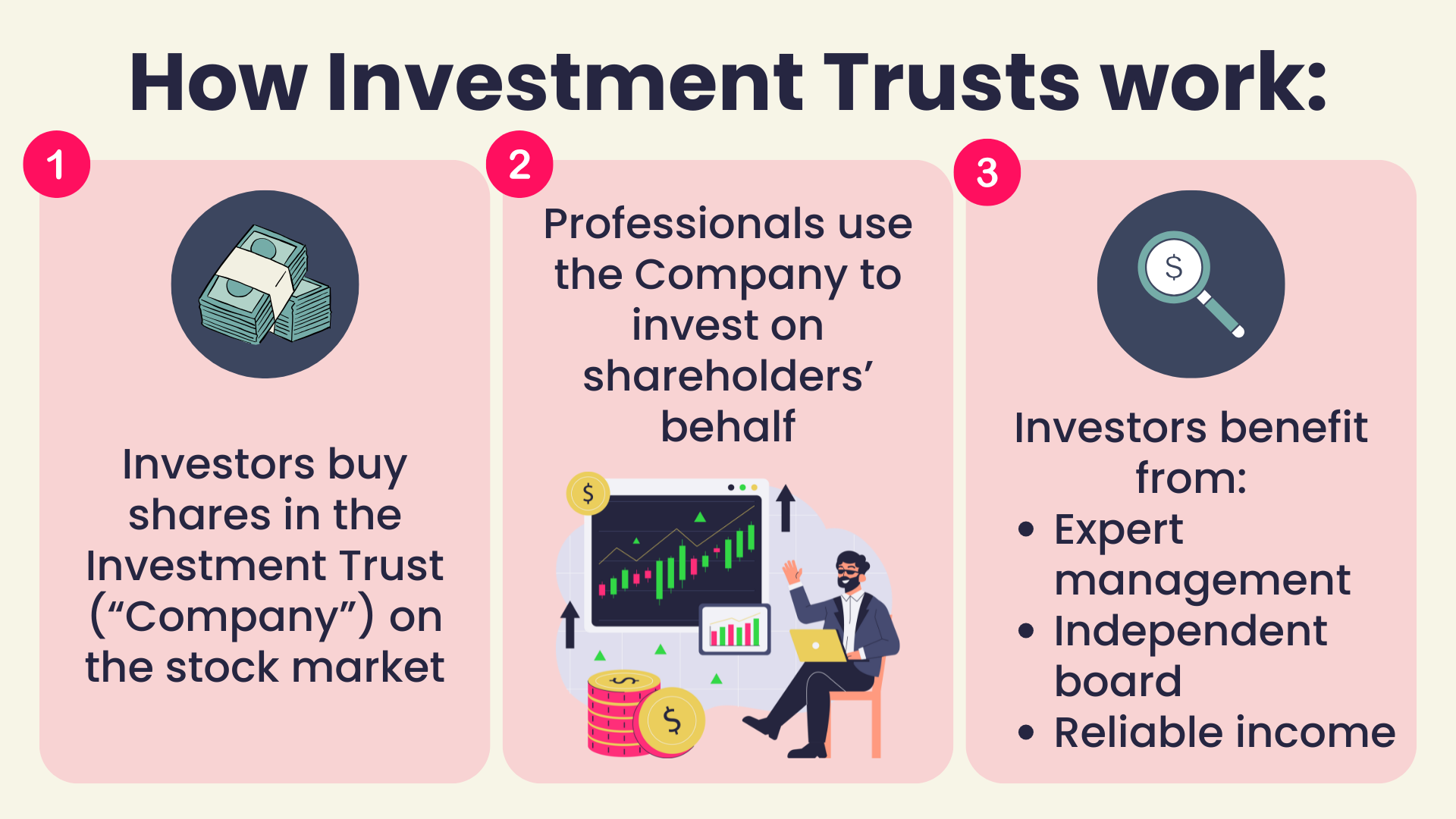
At their core, Investment Trusts are collective investment vehicles which function similarly to a mutual A collection of assets wrapped up in a single product, managed for you by an expert. A fund will hold anywhere from a few dozen to several thousand investments. The specific number depends on the fund’s strategy and objectives.. They pool together the money of investors (the Trust's shareholders) and professionalAn investment expert who is responsible for selecting and managing investments in a fund - or other investment products like investment trusts. They use their expertise to choose what to invest in and how to allocate it within the fund, as well as continually monitoring its performance to ensure it's generating growth for shareholders. then invest this money in a diversified mix of Anything you own that has monetary value. In the investing world, these are the individual things you're investing in. Common examples of assets include shares, bonds, property or cash. - such as shares, A type of asset that represents a loan, usually issued by a government, company or agency that wants to raise money to fund its operations., or property - according to the investment aims of the particular Trust.
Unlike mutual funds, Investment Trusts are structured as closed-ended companies, meaning the number of shares available at any one time is fixed. This structure can lead to shares trading at a When an investment's share price is higher than the total value of all its underlying assets. or When an investment's share price is lower than the total value of all its underlying assets. to the value of the underlying assets (A measurement used to describe the current value of an investment at a moment in time. It's calculated by taking the overall value of a company's total assets and subtracting its total debts or liabilities. It can be expressed as price-per-share by further dividing this figure by the total number of shares.), depending on investor demand.
Investment Trusts can suit a range of different investment styles and goals. You can choose Trusts that focus on specific regions, such as Europe, the US, or emerging markets, or sectors like technology, healthcare, renewable energy, or infrastructure. There are also trusts that focus on niche areas like property or care homes, providing exposure to investments that may be otherwise difficult to access or trade ("When an asset or investment cannot easily be sold without lowering its price - this often happens when there are fewer buyers or sellers in the market. Examples include certain property investments or niche stocks with less demand.").
One of the key benefits of Investment Trusts is their potential to provide regular income. Many Trusts pay cash A cash bonus shareholders get in return for investing in something. Dividends can be paid out on a monthly, biannual or annual basis., which is why they're popular with income-seeking investors such as retirees. Investment Trusts can also retain income in strong years, allowing them to continue paying dividends during more difficult periods - a feature known as dividend smoothing.
In summary, Investment Trusts offer a flexible, expert-led way to invest in a variety of markets and sectors, with the added bonus of potentially generating a regular stream of income too.
Are Investment Trusts right for me?
The pros of Investment Trusts
Investment Trusts suit investors who are comfortable with ups and downs, want broad market access without picking stocks themselves, and trust a professional manager to make the calls.
✅ Potential for higher returns
Investment Trusts can borrow money to try and boost returns with a process called “The act of borrowing money to fund a company's operations. It can be expressed as a ratio, where the cost of the borrowed amount is compared to the overall value of the company - this is called the gearing or leverage ratio. .” If the Trust’s underlying investments do well, borrowing can help make magnify the gains. Also, because Investment Trusts don’t have to sell investments when shareholders take their money out (unlike other types of fund), the manager has the freedom to focus on long-term growth without being forced to react to short-term panic. So investors also benefit from having an expert at the helm with the discretion to make informed decisions to maximise profit. We explain more about gearing in the next section.
✅ Reliable income
Many Investment Trusts are known for providing a steady income, thanks to something called “dividend smoothing.” Unlike regular funds, which have to pay out all the income they earn each year, Investment Trusts are allowed to hold back up to 15% of that income. They can stash it away in a reserve during the good years and then use those reserves to top up payouts in tougher years, when income might dip.
This creates a smoother, more reliable stream of income for investors. It’s especially useful for people who rely on dividends to pay the bills, such as those in retirement, or anyone who simply prefers a consistent drip of income rather than big highs and lows. Some Trusts have done this so well that they’ve managed to increase their dividend every single year for decades, even during financial crises and market crashes.
✅ Independent oversight
Every Investment Trust has its own independent board of directors and their job is to make sure everything’s running as it should. Think of them like a watchdog or a built-in quality control team. They don’t manage the money directly, but they do oversee the An investment expert who is responsible for selecting and managing investments in a fund - or other investment products like investment trusts. They use their expertise to choose what to invest in and how to allocate it within the fund, as well as continually monitoring its performance to ensure it's generating growth for shareholders., making sure they’re sticking to the Trust’s strategy and doing a good job for investors.
If the Trust is performing badly, taking too much risk, or drifting away from its stated goals, the board can step in, ask tough questions, and even replace the manager if needed. It’s their job to put investors’ interests first and hold the manager accountable. This kind of independent oversight is a big plus for Investment Trusts and not something you always get with other types of funds.
The cons of Investment Trusts
Investment Trust share prices can trade at a premium or discount to the actual value of their assets, gearing can amplify losses as well as gains, and smaller or niche trusts can be harder to sell quickly.
❌ More complex pricing
Investment Trusts are listed on the stock market, which means you buy and sell them just like shares. But here’s the catch: the price you pay isn’t always the same as the value of what the Trust actually owns - known as the A measurement used to describe the current value of an investment at a moment in time. It's calculated by taking the overall value of a company's total assets and subtracting its total debts or liabilities. It can be expressed as price-per-share by further dividing this figure by the total number of shares.(NAV).
Sometimes, a Trust’s shares trade at a premium, meaning you’re paying more than the total value of its assets. Other times, they trade at a discount, which means you’re getting the assets for less than they’re technically worth. That can sound like a bargain (and sometimes it is), but it can also be a sign that something’s not right - like poor performance or low demand.
This adds an extra layer of complexity, especially for newer investors. You’re not just looking at how the underlying investments are doing, you also have to think about how the market feels about the Trust itself, which can affect the price.
❌ Volatility from gearing
Gearing can boost returns when markets are rising, as the Trust has more capital working for it. But it cuts both ways. If markets fall, gearing can amplify losses, because the Trust still owes what it borrowed. That means a small market dip can lead to a bigger hit to your investment.
Think of it like going downhill on a bike - fast and fun when things are smooth, but risky if you hit a bump.
Not all Trusts use gearing, and those that do vary in how much. If you're risk-averse, nearing retirement, or might need your money soon, a geared trust may not be the right fit. Always check before you invest - the Association of Investment Companies (AIC) is an industry body which represents Trusts in the UK and is a great place to start your research.
💡 Where to check for gearing
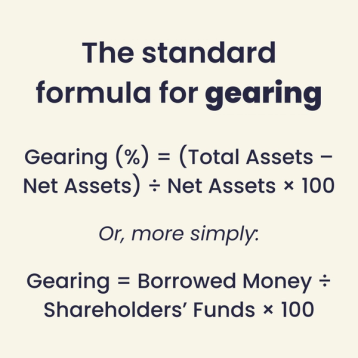
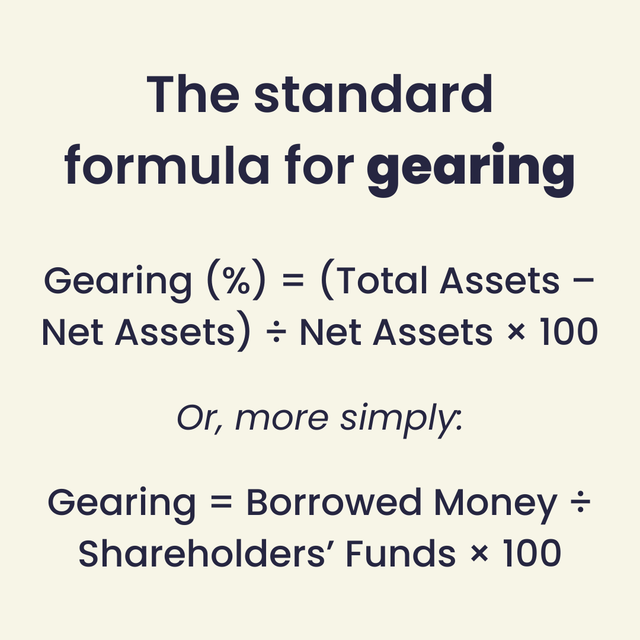
Investment Trust factsheets and/or annual reports typically display the current gearing level as a percentage of total assets. For example, a gearing level of 10% means the trust has borrowed an amount equal to 10% of its net assets, allowing it to invest more than it otherwise could. A non-geared trust will have a gearing level of 0% (sometimes represented as 100% in older conventions), while a geared trust will show a positive percentage.
In terms of how this may look when you're doing your research, here's an example of how prominent An individual or company that creates and manages investments. Asset management firms develop, manage and continually monitor investment products, such as funds. Examples of large asset management firms include BlackRock, Fidelity, and Invesco. BlackRock displays the gearing percentage of its Income and Growth Investment Trust plc as part of its fund information factsheet:
Net asset value (incl. income per share) | 254.25p |
Share price | 224.00p |
Discount to NAV (incl. income) | 11.9% |
Gearing | 4.9% |
Net asset value (incl. income per share) | 254.25p |
Share price | 224.00p |
Discount to NAV (incl. income) | 11.9% |
Gearing | 4.9% |
Source: BlackRock, correct as at June 2026.
❌ Liquidity can be patchy
Some Investment Trusts, especially smaller or niche ones, don’t trade very often. This means it might be harder to sell your shares quickly when you want to (illiquid). If there aren’t many buyers, you could be forced to accept a lower price than you hoped for.
In simple terms, it’s like trying to sell a rare item that not many people want right now. This can make your investment less flexible, which might be a problem if you need cash quickly.
If you’re new to Investment Trusts, it’s worth checking how often a Trust’s shares trade before buying. Larger, more popular Trusts usually have better liquidity, making it easier to buy and sell without a hassle. Here's a breakdown of what to look for:
Feature | What To Look For | Where To Find It |
Average Daily Trading Volume | Higher is better | The AIC, the platform you are using to invest |
Size & Popularity | Larger, well-known trusts are usually more liquid | Trust factsheets, AIC |
Discount/Premium to NAV | Large discounts may signal poor liquidity | Trust factsheets, financial news |
Trading Activity | Frequent trades | Investment platform, London Stock Exchange |
Trust Reports | Notes on liquidity, asset types | Annual/semi-annual reports |
Feature | What To Look For | Where To Find It |
Average Daily Trading Volume | Higher is better | The AIC, the platform you are using to invest |
Size & Popularity | Larger, well-known trusts are usually more liquid | Trust factsheets, AIC |
Discount/Premium to NAV | Large discounts may signal poor liquidity | Trust factsheets, financial news |
Trading Activity | Frequent trades | Investment platform, London Stock Exchange |
Trust Reports | Notes on liquidity, asset types | Annual/semi-annual reports |
Top questions on Investment Trusts
What’s the difference between an Investment Trust and a fund?
The main difference is how they’re structured and how they handle money coming in and out.
- Mutual funds are open-ended, which means new units are created when more people invest, and units are cancelled when people sell. The fund manager has to buy and sell assets to match this flow, which can be disruptive - especially in a market wobble.
- Investment Trusts, on the other hand, are closed-ended. There’s a fixed number of shares, which trade on the stock market like any listed company. This structure gives the manager more control, as they don’t have to constantly juggle the portfolio to meet withdrawals. It also introduces an extra layer - shares can trade at a discount or premium to the value of the Trust’s assets.
What does buying at a discount mean?
Every Investment Trust has a Net Asset Value (NAV) - the total value of all its investments, divided by the number of shares. But because Investment Trusts are traded on the stock market, the share price is set by supply and demand.
- If the share price is below the NAV, the Trust is trading at a discount. You’re buying assets for less than they’re technically worth - a potential bargain.
- If the price is above the NAV, that’s a premium - you’re paying extra, perhaps because the manager has a stellar track record or the Trust is trendy.
Discounts and premiums can widen or narrow over time, adding another element of potential gain or loss.
How to know if an Investment Trust is performing well
To check how well an Investment Trust is really doing, start by looking at its NAV, which shows the total value of everything it owns. Next, compare this NAV to the price you see on the stock market. If the share price is higher than the NAV, the Trust is trading at a premium; if it’s lower, it’s at a discount.
But to understand the Trust’s real performance, don’t just look at the current share price - check how the NAV has changed over time, and see how the Trust’s investments are performing compared to similar Trusts or the wider market. Also, read up on why the trust might be trading at a premium or discount, as this can give you clues about investor confidence or possible problems.
By looking at both the NAV and the share price, you get a clearer picture of the Trust’s underlying strength and how the market feels about it.
Do Investment Trusts pay dividends?
Many do - and some are particularly popular with income investors for this reason.
Investment Trusts can retain up to 15% of the income they earn each year and hold it in a revenue reserve. This acts like a rainy-day fund to top up dividends when times are tough - say, if the underlying companies cut or cancel dividends during a market downturn. This is called "dividend smoothing".
This allows some Trusts to maintain or even increase their dividend payments year after year, which is when you’ll hear about “dividend heroes” - Trusts with a decades-long track record of growing their payouts.
What are the most popular Investment Trusts in 2026?
Curious where other investors are putting their money right now? Each month, we go straight to the source - top UK platforms like AJ Bell, Fidelity, Hargreaves Lansdown and interactive investor - to find out which Investment Trusts are trending.
Whether you're after inspiration, reassurance, or just a nosey peek at the crowd favourites, our regularly updated list reveals which Trusts are winning the popularity contest. Click below to see the latest chart-toppers and discover the Investment Trusts investors are backing this month.
Best-selling funds, Investment Trusts and ETFs of the month
Key takeaways on Investment Trusts
🧺 Expert-run basket of investments
Investment Trusts give you instant access to a ready-made portfolio, professionally managed and listed on the stock exchange. They’re ideal if you want long-term exposure to a range of assets without having to pick and mix dozens of individual assets yourself.
📉 Unique structure brings opportunity - and complexity
Because Investment Trusts are closed-ended and trade like shares, they can offer unique benefits like dividend smoothing. But you’ll also need to get to grips with concepts like discounts, premiums, and gearing - all of which can affect performance and are not always a good thing.
🧠 Best for confident, long-term investors
On the whole, Trusts are not beginner-level “set it and forget it” products. They’re better suited to investors who are comfortable with a bit more risk and prepared to do some research - or at least know when to sit tight during the wobbles.