



First ISA Guide: How to Open Your First ISA in 3 Steps
By Boring Money
2 Jan, 2026
Thinking about opening your first ISA? An ISA (Individual Savings Account) allows you to save cash or invest without incurring tax. If you're not sure where to start, this guide covers everything you need to know.
First things first, why should you get an ISA?
The main appeal of an ISA is simple: you don't pay tax on the money you make. Whether that's interest from cash savings or returns from investments, it's all yours to keep.
First things first, if you're reading this before April, you still have a good few weeks to get your ISA up and running in order to take advantage of this year’s ISA allowance. Leave it much later, though - past the 6th of April to be exact - and you risk losing it.
What does all that mean? Every tax year (that’s 6 April to 5 April the following year), every adult in the UK is allowed to put £20,000 into their ISAs, and any money earned from these accounts is tax-free. So any interest on cash, or returns or dividends from investments, is free from Capital Gains Tax and Dividend Tax, which could otherwise eat away at your profit.
If you invest outside of an ISA, for example, higher-rate taxpayers could end up paying as much as 20% of investment returns back to the taxman in Capital Gains Tax. Or if you have a standard savings account, are a higher rate taxpayer, and you earn more than £500 in interest, the amount over this threshold could be added to your taxable income, and you would be liable for Income Tax.
Maybe you’ve inherited money, been paid a bonus from work, or regularly have some money left over after your outgoings, and could set up a monthly direct debit from your current account. If so, now would be a great time to get organised and cross off the ‘ISA’ entry on your to-do list.
Our article here explains more about the benefits of investing rather than just stashing your money in a savings account.
If you’re ready to open your first ISA, there are a few rules to get your head around.
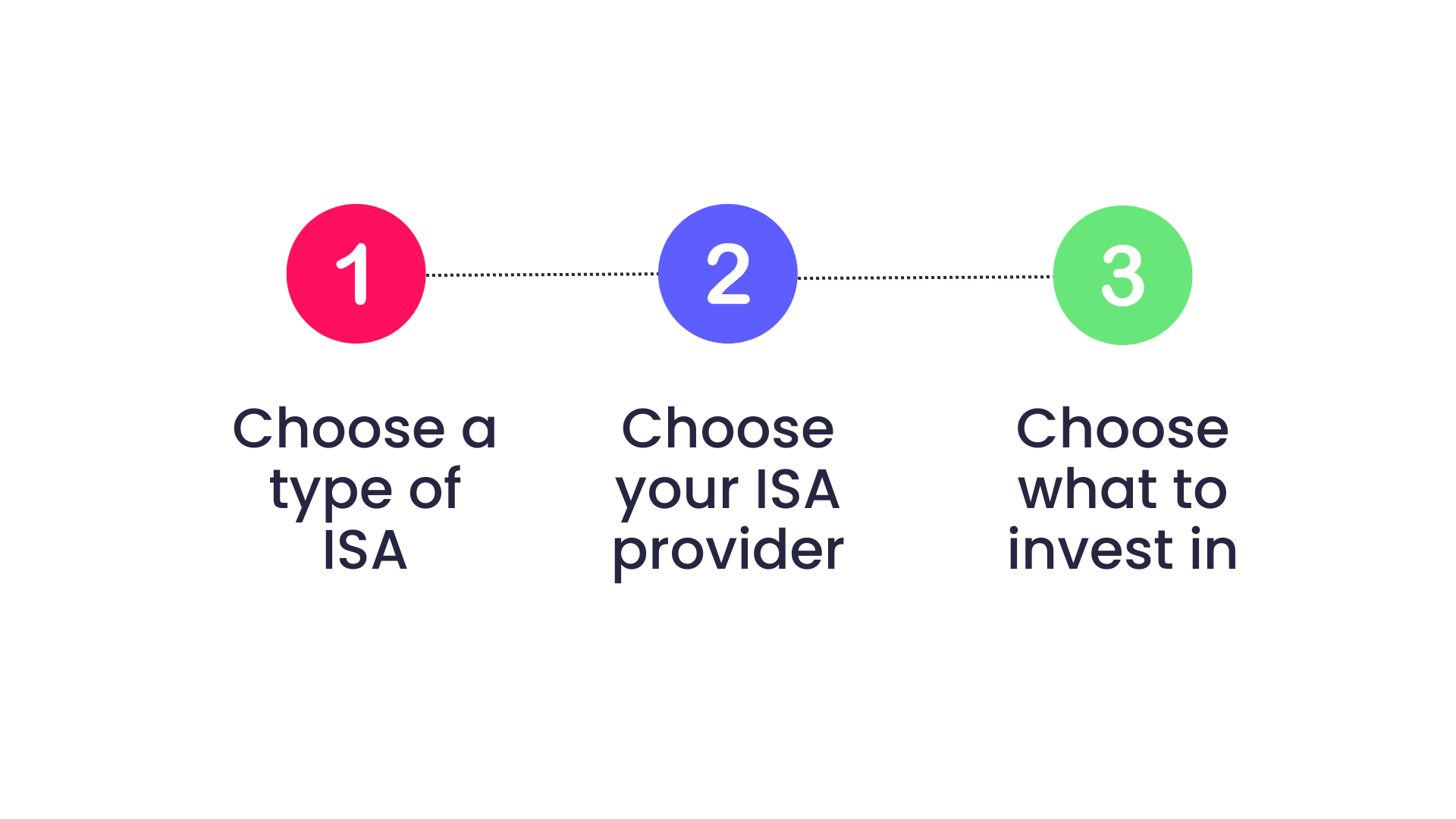
1. Choose a type of ISA
The type of ISA that’s right for you will be different depending on your financial needs, such as who and what you’re saving for and when you’re going to need to access your money. There are four main types of ISA, each of which works differently and is designed for a different purpose.
Cash ISA
Does what it says on the tin. A Cash ISA is like a regular savings account except that any interest you earn on your cash is shielded from tax. You can save up to £20,000 in one Cash ISA per tax year. For more details on how they work, make sure you read our full guide here.
Best for: Someone who prefers the safety of cash or who is likely to need to access their money soon or at short notice.
Stocks & Shares ISA
This type of ISA allows you to invest in the Public markets where buyers and sellers trade shares of publicly listed companies. They are physical places in the real world - like the London Stock Exchange in London or the New York Stock Exchange in New York City.. Any gains or A payment made by a company to its shareholders, typically representing a distribution of the company's profits.from your investments are shielded from tax – specifically Capital Gains Tax (which can be as high as 20%) and Dividend Tax (which can be as high as 39.35%). Essentially, a Stocks & Shares ISA can help you to keep your investing profits for yourself rather than having to share it with the taxman! Similarly, you can save up to £20,000 in one Stocks & Shares ISA per tax year. For a breakdown of this ISA’s rules and the key things you need to know, check out our full guide here.
Best for: Someone who wants to invest in the stock market to make their money grow over a longer period of time, typically 5 years+.
Lifetime ISA (LISA)
Lifetime ISAs are designed to help you buy your first property or, if you’re looking further down the line, to put towards your retirement savings. You need to be aged between 18-39 to open one, and then the government gives you a top-up with a 25% bonus. The maximum you can put in annually is £4,000. So if you paid in this much, the government would give you an extra £1,000 for free. Bargain! However, you can only withdraw your funds from a Lifetime ISA for the purpose of purchasing your first property or retirement income. If you withdraw for any other reason, you will incur a penalty charge which wipes out the free top-ups – so best to avoid unless you’re certain you will use it for either of these reasons. For the full breakdown, head over to our full guide here.
Best for: Someone who is either saving up to buy their first property or building up their retirement savings and will benefit from extra help in the form of a cash top-up from the government.
Junior ISA (JISA)
The Junior ISA – which comes in both a Cash and Stocks & Shares variety – lets you save money on behalf of the kids. You can open one for your child any time between birth and their 18th birthday. The catch here is that the little one can’t access the money within the account until then (maybe that's a good thing, though!). Most Junior ISAs automatically roll over onto an adult ISA after this point. You can put up to £9,000 into each Junior ISA every tax year. Read everything you need to know about Junior ISAs in our guide here.
Best for: Someone who wants to put money away for their children (as long as they are under the age of 18).
Types of ISA compared
ISA type | Age | Maximum annual deposit | Government bonus | Best for |
Cash ISA | 16+ | £20,000 | No | Someone who prefers the convenience of cash or needs their money soon/at short notice |
Stocks & Shares ISA | 18+ | £20,000 | No | Someone who wants to invest over a longer time period, typically 5 years+ |
Lifetime ISA | 18-39 | £4,000 | Yes - 25% | Someone who is either saving up to buy their first property or for retirement |
Junior ISA | 0-17 (must be opened for children aged 15 or younger, 16-17 year olds can open their own). Usually automatically rolls over into an adult ISA once they turn 18 | £9,000 | No | Someone who wants to put money away for their children or grandchildren |
❗ Remember the annual ISA allowance
Important to note, your £20,000 annual ISA limit covers all your ISA accounts - except for Junior ISAs (because these are registered under the child's name). For example, you could put the full £20,000 into one Stocks & Shares ISA, OR you could put £10,000 into a Cash ISA and £10,000 into a Stocks & Shares ISA. As long as your total ISA contributions do not exceed £20,000 within a single tax year.
2. Choose your ISA provider
Now you’ve decided which type of ISA you want to open, it’s time to decide who you want to buy it from – that is, which ISA provider to go for.
But how do you know who’s actually any good? There are dozens of ISA providers in the UK, and because the ISA rules (e.g., the £20,000 annual allowance) are the same across the board, it can be hard to tell what sets any one of them apart from the rest.
That’s where we can help. Every year, Boring Money’s in-house team of analysts spend months testing, reviewing, and curating a hand-picked list of the very best ISAs across the entire market. We run live accounts, test customer service, model fees and charges, and collect real customer reviews to bring you our independently selected shortlist. These impressive providers are recognised with our coveted Best Buy ISA award.
You can see the winners, read our full reviews, and visit their websites by clicking the link below.
Discover the winners of the 2025 Best Buy ISA award
3. Choose what to invest in
Great – you've decided which ISA you want to get and which provider to get it from! You might have even opened an account already. But once you’ve done this, how do you know what you should be putting in your ISA?
If you’ve opted for a Cash ISA, LISA, or JISA, then it’s pretty straightforward – just top up your account with cash. However, if you’ve got an investment (Stocks & Shares) ISA, you’ll need to decide what you want to invest your money in.
Boring Money can help you with this, too. Here’s a breakdown of some of the key considerations.
a) Type of investment
There are many different types of investments (also called ‘assets’) you can put in an ISA. These may include (but are not limited to):
- UK, US, and international shares
- Funds
- Ready-made investments
- ETFs
- Investment trusts
- Bonds
Many providers allow you to create your own pick n’ mix from their available options. Others, commonly called ‘robo advisers’, will give you a short quiz and use your answers to suggest a ready-made investment (usually a single fund) which contains a mixture of different assets already picked for you based on your needs and goals.
b) Level of risk
As well as which type of asset you go for, it’s also important to consider how much ‘risk’ you’re willing to take on.
As a general rule, someone who is on the younger side and has lots of time to invest may want to consider investing in ‘higher risk’ products. These are investments whose prices are more likely to move up and down in value - sometimes at very short notice - such as shares on the stock market and funds, ETFs, or ready-made solutions which have a majority invested in shares. Essentially, how much exposure you have to the stock market.
Someone who is investing over the longer term has more time to ride out any dips and troughs in the market than someone who is older and will need to cash in sooner. So you can afford to take on more risk because you have more time to make up for it.
Alternatively, someone who is a bit older – perhaps gearing up for retirement – may want to think about reducing risk to protect the value of their savings. They may want to invest in or increase their exposure to ‘lower risk’ investments, which can include things like bonds (typically considered to be lower risk than the stock market) and other assets with less exposure to the stock market. Someone in this group may find that their priority is to preserve their money, rather than grow it.
c) Make sure you're diversified
A good rule of thumb that applies to all investors is to make sure you diversify your investment portfolio – in other words, don’t put all your eggs in one basket!
It’s important to have a blend of different Anything you own that has monetary value. In the investing world, these are the individual things you're investing in. Common examples of assets include shares, bonds, property or cash. in different portfolios to make sure you spread your risk. That is to say, if you had all your money in bonds and bonds had a bad year (as they did in 2022, for example), then you’d take a significant hit. But if you had some shares in your portfolio too and these performed well, this would help to counteract the downward impact of the poorly-performing assets.
So, regardless of what you choose to invest in, make sure you diversify. This could mean investing in lots of different types of individual assets (e.g. shares, funds, and bonds) or even different parts of the world (e.g. US, Europe and Asia) in order to spread your risk and hedge against any unexpected dips.
d) Do your research
If you’re still not sure where to start, we’ve got a few ways to help!
Take our free course
To take it back to basics and get your head around investing once and for all, try our 7-step course Investing For Beginners. Our Founder, Holly, will run you through everything you need to know to take those all-important first steps into the world of investing.
See what’s popular
If you're a bit further into your investment journey and ready to start choosing products and providers, why not see what others are investing in?
Make sure you check out our monthly best-selling funds list. Every month, we collate the most popular funds, ETFs, and investment trusts across several investment providers, so you can see what other investors are backing at the moment.
Or, for those who are curious about ready-made investments specifically, we chart the performance of the most popular ones on the market in our quarterly ready-made investments performance series. You can use this to see which investments and providers came out on top in the preceding quarter, as well as over the last couple of years.
Get an expert’s opinion
Finally, if you'd value the input of a qualified professional, you may be able to consult a financial adviser to help you. Use our contributors directory to browse financial advisers, planners, and coaches across the UK.
Want to find out more about ISAs?
Do you want to learn more about ISAs? Head over to our ISA Hub by clicking the link below.
Discover more about ISAs