


Bonds vs Equities: Where Are the Opportunities Now?
Written by Boring Money
13 April, 2026
Global markets have been volatile since the US, Israel and Iran war began, with bond yields rising and stock markets swinging on every headline. Neither bonds nor equities are a clear winner right now — but there are pockets of value in both. UK gilts are offering their highest yields since early 2025, while equities in emerging markets, healthcare and UK small caps look cheap relative to history. Mega-cap US tech remains expensive. This article breaks down where the opportunities are, and what leading fund managers are doing with their money.


The war between the US, Israel, and Iran has thrown global financial markets into turmoil. Bond
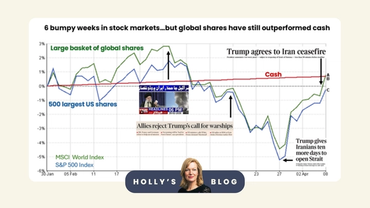
and equity markets have been bouncing around with every move in the oil price, truth social from the President, or sign that the peace negotiations could be underway. Bewildered investors may be wondering whether they should be leaning into stock market volatility or securing some of the attractive income now on offer in bond markets. Neither is a clear winner, but there are opportunities in both areas.Which sectors are winning — and which are lagging?
Although stock markets are almost back to their level in late February when the crisis started, the laggards and leaders look a little different. Research from Evelyn Partners shows that, unsurprisingly, the energy sector has been the biggest winner from the crisis so far – with the MSCI World Energy index up 6.2% since late February. Investors hoping to ‘buy the dip
’ on the expensive US mega-caps have also been disappointed – the MSCI World Information technology index is up 1.4% over the period, while the Nasdaq is up 0.9%.The laggards have been MSCI Emerging Markets, down 4.9%, with healthcare, UK small caps and India other noticeable weak spots. In some of the cases – India, China, for example – the reason for the weakness is clear. India is a significant oil importer and its growth could be compromised by higher oil prices. In other areas – healthcare perhaps – the weakness is more difficult to fathom. UK small caps could prove vulnerable to higher interest rates, but there is no sign of it in company reporting.
Are stock markets cheap enough to buy right now?
Where does this leave investors? Stock markets are not – in aggregate – cheap. Tom Stevenson, investment director, Fidelity International, says that investors are currently sitting on their hands:
Markets fell back after the conflict began five weeks ago but never really plumbed the depths at which they were obviously oversold. The stocks which had been driving markets higher last year and into this - those closest to the AI story - have bounced back to new highs but without really dragging the rest of the market up on their coattails.

He says market valuations had fallen around 19% from the peak, and last week’s rally took the valuation correction back to about 13%.
Those cheaper valuations provide some justification for share prices at today’s level. They point to a news-driven market from here, with positive indications from the Gulf fuelling further rallies and bad news leading to pull backs.
That’s not a clanging ‘buy’ signal, but there are selective opportunities. Areas such as emerging markets, healthcare and consumer staples appear to offer better value, while megacap technology looks as expensive as ever. The exception is in the software sector, which has been caught up in the ‘AI losers’ trade. Microsoft, for example, is down over 20% this year. Brave investors may find some value there. The same is true for UK small caps
, which are as cheap as they have ever been, but could remain lacklustre until interest rate expectations shift.What's happening to bond yields — and are gilts worth buying?
Are bond markets a better bet? In bond markets, the moves have been more extreme. The whipsaw in interest rate expectations has sent some government bond markets into turmoil, particularly in those countries seen as most at risk from higher energy costs or with higher debt. The UK has been the poster child for this phenomenon, with the UK 10 year gilt yield
moving from 4.2% in late February to its current level of around 4.8% (yields move inversely to prices).That means investors are getting a higher income for their investment today than they have since January 2025. For a risk-free investment (the UK government has never defaulted on its debt), that appears to be a reasonable return. Some fund managers believe that gilts look like a good investment at these levels. David Roberts, head of fixed income at NedGroup, for example, has been buying into recent weakness and points out that the UK’s debt situation is actually better than some of its developed market peers.
David Coombs, head of multi-asset investing at Rathbones, says gilt yields aren’t quite high enough to entice him yet, but he is still seeing opportunities in other government bond markets:
We’ve been buying New Zealand, Australia, Norway, and US, because the yields are so high that they do protect you. A yield 4.5-5% is not to be sniffed at.
He believes government bonds look a lot more attractive than corporate bond markets, where investors aren’t being rewarded for risk. Credit spreads – the compensation investors receive for taking the risk on a corporate bond over a government bond – have remained at historically low levels.
In the battle of global financial markets, neither bonds nor equities are a clear winner, but there are selective opportunities within each area. Investors looking for obvious bargains amid the current volatility may be disappointed, but there are clear pockets of value emerging.
Post a comment:
This is an open discussion and does not represent the views of Boring Money. We want our communities to be welcoming and helpful. Spam, personal attacks and offensive language will not be tolerated. Posts may be deleted and repeat offenders blocked at our discretion.