


What Does the Oil Price Spike Mean for Your Investments?
Written by Boring Money
19 Mar, 2026
Oil prices have shot past $111 a barrel after Iran largely closed the Strait of Hormuz — a crucial shipping route for a quarter of the world's crude oil. That's bad news for inflation, potentially for interest rates, and possibly for your mortgage. Stock markets are wobbling but haven't crashed yet. The big question is how long this lasts — and the answer will determine whether we're looking at a temporary headache or something much more serious. We break down what's happening, what the experts think comes next, and where investors are finding shelter in the meantime.

The relationship between financial markets and oil is a bit like your boiler. You never think about it until the day it stops working — and then it's the only thing on your mind. As it stands, investors across the world are watching every blip higher in the oil price with mounting trepidation.
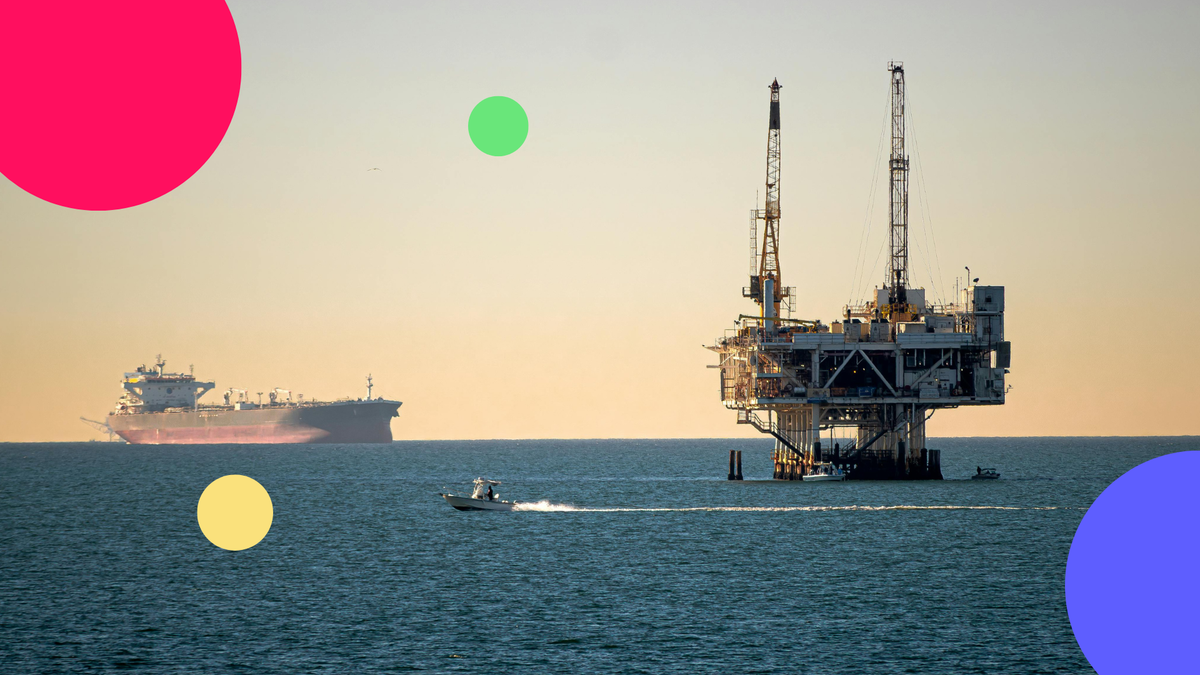
The problem is clear-cut. Around 25% of all vessels carrying crude oil and 20% of those carrying liquified natural gas pass through the Strait of Hormuz, which runs between Iran and the Gulf States. Following US and Israeli attacks, Iran has largely cut off this passageway, restricting global supplies of fossil fuel.
This supply constraint has sent oil and gas prices soaring. At the time of writing, the price for Brent crude stood at $111 a barrel, almost double its level at the start of the year, while the UK natural gas price is more than double its level in February. This has an impact on inflation, both through the cost of petrol and heating, but also through higher costs for companies that are then passed on to consumers. It may put pressure on central banks to lift interest rates, which has a knock-on effect for mortgage rates and business borrowing costs.
For the time being, stock markets are in a type of phoney war. They have been unstable, but have not seen the precipitous drops that might be expected with the global economy facing a potential shock of this kind. In most cases, markets are simply back to where they were at the start of the year. Compare that to the Covid shock, where the Dow Jones dropped 26% in four days.[1]
What are some possible scenarios?
The outcome, for the time being, is unknowable. There is poor and contradictory information coming out of the White House, with Donald Trump claiming to have won the war already, but also needing European countries’ aid to reopen the Strait. There has been escalation in the form of Iranian attacks on Qatar’s Ras Laffan gas complex, which provides a fifth of the world’s liquefied natural gas, in retaliation for Israeli attacks on Iranian infrastructure.
There remains a huge amount of uncertainty…President Trump is talking about escort convoys to get oil exports flowing, but even with agreement across various nations those measures will take some time to set up. In the short term there are clear upside risks to inflation and economic growth from oil prices standing at more than $100 per barrel.”

Central banks have already abandoned forecast interest rate cuts, with the Federal Reserve, Bank of England and European Central Bank all keeping rates on hold in their latest meetings.
Michael Browne, global investment strategist at the Franklin Templeton Institute, has come up with four possible scenarios.
Scenario 1
The first, and most optimistic, sees the war ending in days. In this case, the price of oil per barrel would likely retreat below US$80 almost immediately.
Banks would likely change language, become data-driven, and adopt a wait-and-see posture about interest-rate cuts. There would still likely be some inflation to come, but it should be limited and likely to recede. We would see virtually no impact on business and consumer confidence.
However, that scenario now appears vanishingly unlikely. Even if the US retreats today, Israel and Iran are likely to remain at war.
Scenario 2
Scenario 2 would see the Strait of Hormuz remain closed until early to mid-April. That would see oil prices peak between US$100 and US$110 per barrel, and the price returns to US$80 in June. Even this would create real problems.
Fuel and some food prices, along with overall household bills, would likely rise…It is likely that business and consumer confidence will have weakened sharply, cutting demand and pausing capital expenditure.
He says this is the scenario considered most likely by markets.
Scenario 3
The outcomes become progressively worse in scenarios 3 and 4. If the Strait re-opens by the end of May, oil prices are likely to exceed US$120 during April, and at times rise near to US$140.
As in 2022, prices might not fall to US$80 until year-end. Inflation would become very evident across economies, and it would become probable for peaks between 6% and 10%, as in 2022. Bonds and equities would sell off further.
Interest rates could rise marginally in this scenario, possibly by 0.25% in the UK and Europe. This would start to look like stagflation
.Scenario 4
If the Strait remained closed until June, and oil peaks at over $150, steeper rate rises in Europe, and the UK would be on the cards.
Earnings estimates for equities would turn negative as the full stagflation trade comes into place. Those economies that can subsidise domestic fuel prices may do so, but most country balance sheets would not be strong enough for such measures.
There would be a significant hit to growth, possibly even recession
.Investor protection
As with 2022, in environments like this, bonds
and equities can sell off in unison. Both are sensitive to inflation and interest rates. In 2022, the key sources of investor protection were commodities and global equity income funds.It has been a similar picture this time round. Energy related companies have done well, as have some of the renewable energy companies and investment trusts. Darius McDermott, managing director of Chelsea Financial Services, has been selectively buying energy company ETFs for the group’s VT multi-asset range of funds. The group already held some renewable energy investment trusts, mostly for their high yields, but has been topping up further.
We have been raising our oil exposure through the iShares MSCI World Energy ETF across our funds, but we’ve also bought more renewables. They should be beneficiaries of higher energy prices and already had yields of 10-12%.
He was already cautiously positioned going into the conflict on the basis that equity markets had seen three years of strong gains.
David Harrison, head of sustainability at Rathbones Asset Management, agrees it may be a moment to look again at renewable energy options:
The Climate Change Committee’s advice alongside the UK’s seventh carbon budget made this clear: fossil fuel price spikes have triggered around half of UK recessions since 1970, underlining just how exposed the economy remains to volatile global markets.
He believes that measures such as the uptake of electric vehicles, distributed storage, AI‑enabled grid optimisation and better harnessing of periods where supply outstrips demand would contribute to a more resilient, affordable energy system.
Our exposure to energy infrastructure reflects these realities. We continue to hold many of the ‘picks and shovels’ of the transition—from operators like National Grid and E.ON to companies such as Schneider Electric and Quanta Services that are modernising grids and expanding storage. Linde, the world’s largest installer of hydrogen technology, has long been a core holding given its role in helping major energy companies decarbonise their infrastructure.
It would be good to say it isn’t grim out there, but – potentially – it could be nasty. Oil is still vital for the smooth running of the global economy. Like your leg, you only really miss it when it’s not working as it should. At the moment, the leg is still broken, and the recovery time is uncertain.
—-
[1] Science Direct, 2021
Post a comment:
This is an open discussion and does not represent the views of Boring Money. We want our communities to be welcoming and helpful. Spam, personal attacks and offensive language will not be tolerated. Posts may be deleted and repeat offenders blocked at our discretion.