




Are markets more volatile now than ever — or does history tell a different story?
14 April, 2026
Question by Boring Money reader
How does the volatility of the last 10 years compare to the biggest stock market crashes of the past century, and what do the recovery periods tell us?
Answered by Boring Money
The short answer is no — and the history makes that case better than any reassurance could.
Major stock market crashes, defined as falls of 20% or more, have happened roughly every eight to ten years over the past century. Which sounds alarming, until you look at what actually happened in those crashes — and what came after.
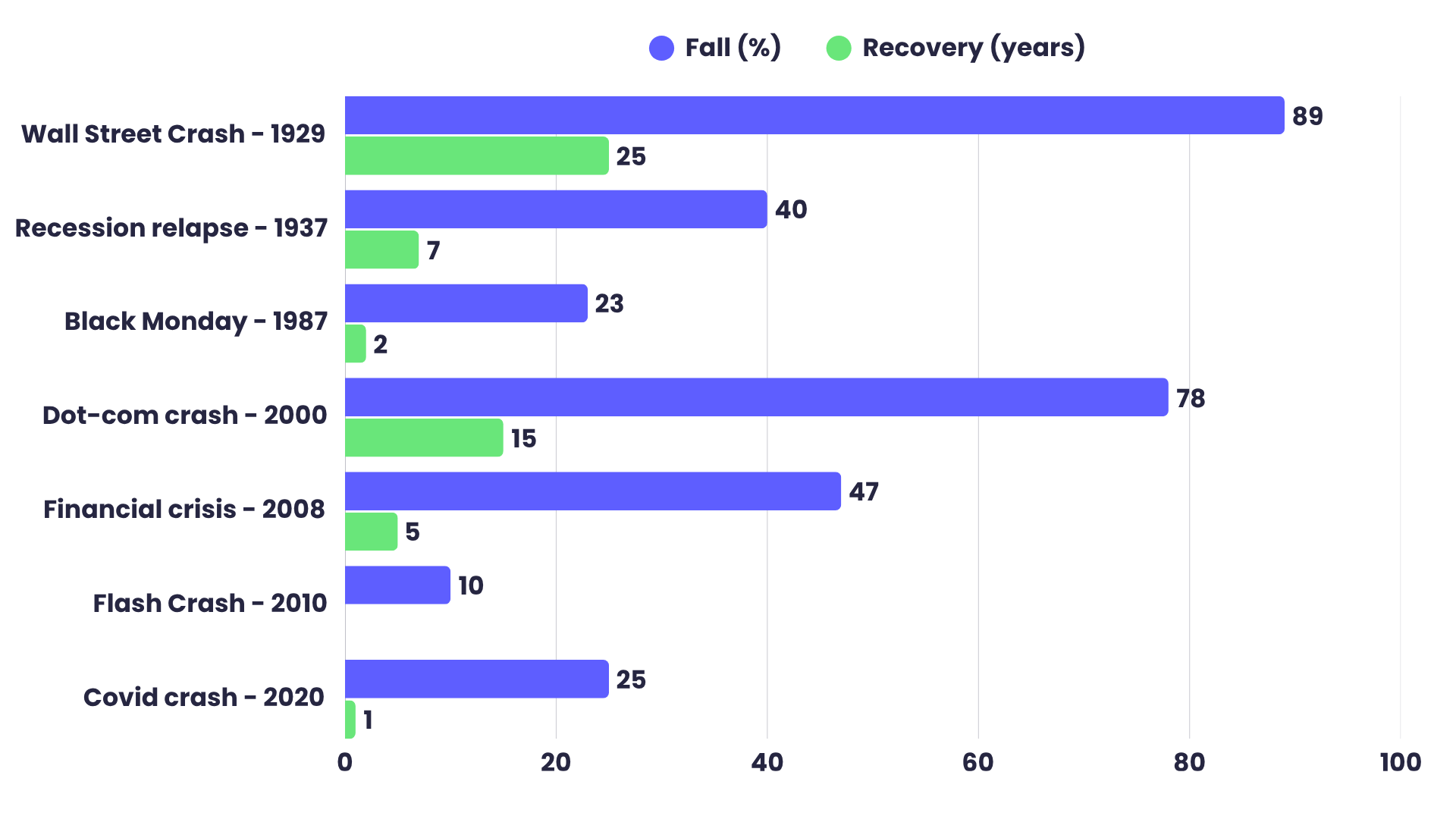
The past 100 years contained the genuine disasters. The 1929 Wall Street Crash wiped 89% off the Dow Jones and took 25 years to fully recover. A second major crash followed in 1937, before anyone had healed from the first, with the Dow dropping a further 40% and taking around seven years to recover. The dot-com crash of 2000–2002 saw the Nasdaq fall 78%. The 2008 financial crisis sent the FTSE 100 down 47%, with investors waiting until 2013 to break even — though dividends softened the blow throughout. These were existential-level events, not corrections.
The shorter, sharper crashes tell a different story. The 1987 Black Monday fall of 22.6% in a single day felt catastrophic in the moment — within a decade, a £10,000 investment had become £32,690. The Covid crash of 2020 dropped the FTSE 100 25% in a matter of weeks and recovered within months.
Compared to all of this, the past ten years look relatively mild. The 2022 bear market hit growth stocks hard, and 2025's tariff-driven volatility has rattled nerves. But the broad direction of markets has been upward. The S&P 500 is multiples of where it was in 2015, and long-term investors who held through 2022's falls were largely still ahead.
The outliers matter too. Japan's Nikkei peaked in 1989 and didn't recover until 2023 — 34 years. That's not a recovery story most investors can afford to wait for, which is why spreading investments across geographies matters as much as staying patient.
What makes today feel worse than it is comes down to recency bias — recent pain is immediate and personal in a way that reading about 1929 simply isn't. But the numbers don't support the anxiety. Across the last 100 years, a globally diversified investor who stayed invested through every crash on this list would have ended up significantly ahead. Not because crashes didn't happen — they happened repeatedly — but because time in the market consistently outweighed the timing of it. If markets survived 1929 and 2008, the question isn't whether today's volatility is the worst ever. It clearly isn't. The question is whether you're positioned to stay patient long enough for the recovery that history says is coming.
Read a deeper analysis of the past 10 years
