




Q4 2025 Ready-Made Portfolio Returns: Which Portfolios Performed Best?
Compare performance data across high, medium and low risk solutions
By Boring Money
16 Jan, 2026
Every three months we get performance data from the leading ready-made investment portfolios made available to retail investors. We group these into three The uncertainty or potential of significant price fluctuations on an investment. categories and take a look at who has performed best over various timeframes after all fees and charges have been taken into account.
Important stuff: Our content is aimed to help readers’ understanding but it does not constitute any form of advice or recommendation. Investing is a long-term process, and shorter-term performance information alone won’t support robust choices. Investments can and will go up and down in value.
How did ready-made solutions perform in Q4 2025?
Ready-made solutions recorded another strong quarter at the end of 2025, as global stock markets continued to power ahead. A number of global stock markets hit new highs, including the S&P 500 and FTSE 100. The US technology giants continued their strength, even if there was a growing drumbeat of concern over valuations. Sectors and regions beyond the US were as strong, or even stronger, as investors continued to expand their horizons.
There was a revival in some unloved areas, such as healthcare and smaller companies. Emerging markets had a strong quarter, fuelled by a number of Asian technology names, but also by Eastern Europe, frontier, and Latin American markets. The MSCI Europe ex UK index returned almost double that of the MSCI World index over the quarter[1], setting the stage for greater diversity of returns in the year ahead.
Every ready-made solution we track posted a positive return over the quarter; the majority of high risk solutions outperformed their medium risk counterparts, who in turn outperformed the majority of their low risk solutions. This is what would be expected in normal market conditions, where investors are rewarded for taking additional risk. The gap between the top and bottom funds was 3.7%.
The average return of a high risk portfolio was 3.6%, equivalent to £36 profit on a £1,000 investment over the past three months. This is notably lower than the previous quarter, where investors made an average of 8.3%. Medium risk portfolios returned an average of 2.8%, whilst low risk portfolios came in with an average of 1.7%. It capped a strong year for ready-made portfolios, where most investors have seen double-digit gains.
What were the average returns by risk category?
The table below illustrates the average performance of ready-made solutions from the three risk categories - high, medium and low - across the different time periods we track:
Risk Level | Q4 2025 AVERAGE NET GROWTH | 1 YEAR AVERAGE NET GROWTH | 3 YEAR AVERAGE NET GROWTH | 5 YEAR AVERAGE NET GROWTH |
High Risk | 3.6% | 14.1% | 46.8% | 56.3% |
Medium Risk | 2.8% | 11.1% | 32.7% | 31.0% |
Low Risk | 1.7% | 7.0% | 18.8% | 10.6% |
Disclaimer: Investing is a long-term process, and investment decisions must not be based solely on past performance, especially over short timeframes.
High Risk Ready-Made Portfolio Performance
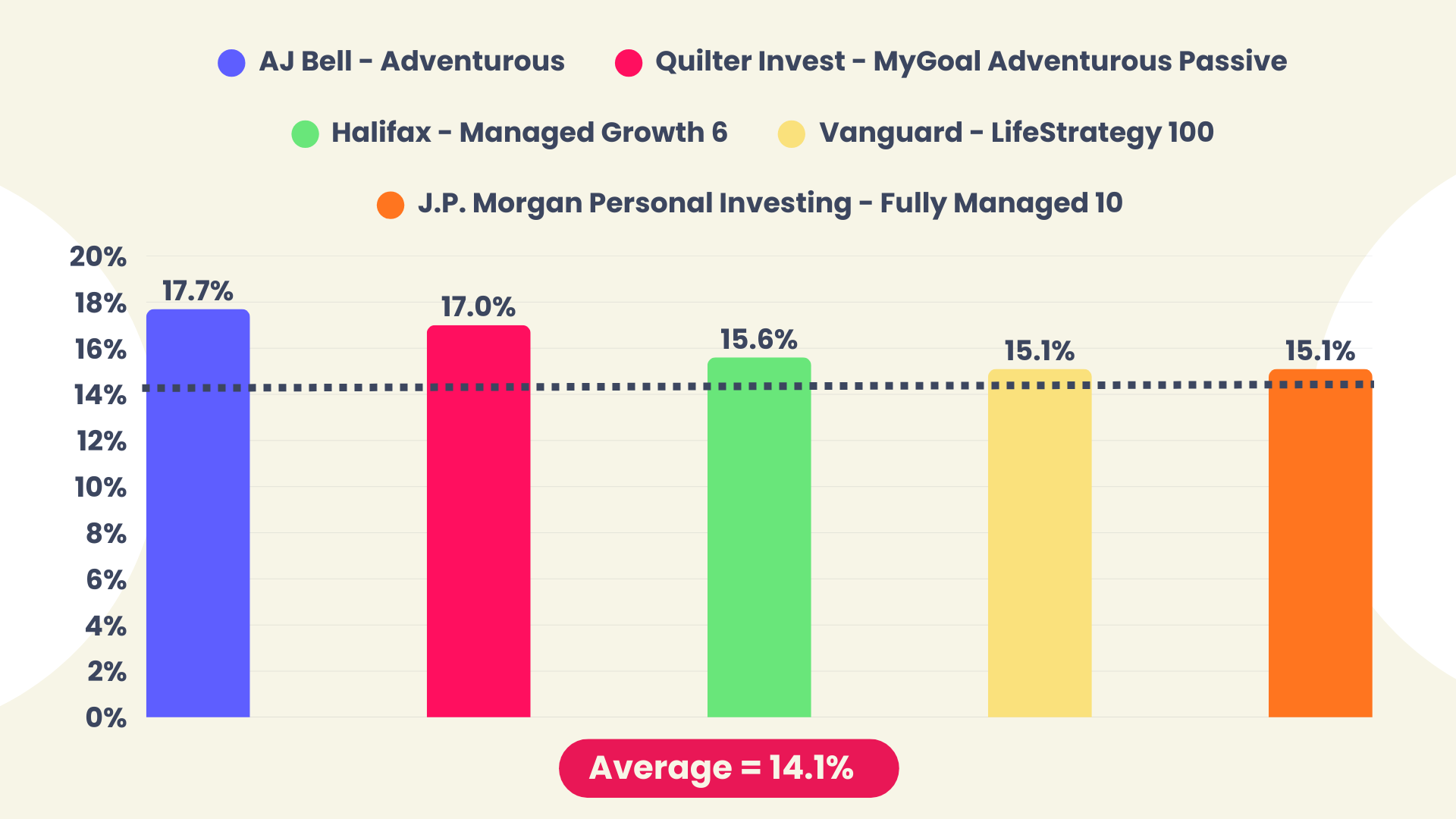
Graph illustrating net returns for one year, covering January 2025 - December 2025, of the top 5 performing ready-made solutions against the average of all of the high risk funds/portfolios covered in our analysis. Data correct as at 31 December 2025. Returns calculated net of charges. The full fund/portfolio names can be found in the table below.
Which high risk portfolios performed best in Q4 2025?
Quilter's MyGoal Adventurous Passive portfolio is a top 2 performer across all timeframes covered. When looking at a shorter timeframe, AJ Bell's Adventurous portfolio is the top performer over Q4 and a 1-year period.
Why did AJ Bell outperform Quilter in Q4?
AJ Bell’s Adventurous portfolio and Quilter's MyGoal Adventurous Passive portfolio have fought for the top spot over 2025. The AJ Bell portfolio nudged ahead in the final quarter, delivering a return of 4.5%, compared to 4.2% for the MyGoal portfolio. AJ Bell also has the edge over 1 year, with a 17.7% return – broadly in line with that of the S&P 500 – while MyGoal has delivered 17.0%. However, MyGoal is ahead over three years, with a 57.6% return versus 41.4%. Aviva’s Multi-asset Plus portfolio took the third spot over the quarter.
What drove high risk portfolio returns in Q4 2025?
After a strong third quarter, returns in the fourth quarter of 2025 were more diversified. Although technology did well, it was not the stand-out performer. That prize went to Europe and emerging markets, as investors hunted for better value opportunities across the world.
The average high risk portfolio returned 3.6%, with returns ranging from 3.0% - 4.5%. Moneybox Adventurous was the weakest performer over the quarter, and also the weakest over 12 months, though its three and five year track record is stronger.
The level of equity allocation was not necessarily a determinant of higher returns. Aviva Multi-Asset Plus and Vanguard Life Strategy 100 both have the highest equity weightings at 100%, and they were third and fourth, respectively, in this quarter’s tables. A high equity weighting (95%) did not save the Moneybox Adventurous fund from weak performance. Here, performance may have suffered from its allocation to property, which had a very weak quarter[2],[3].
Over one year, every fund in the high risk category has delivered double digit returns. However, most are below the return from the MSCI World index[4], which rose 21.6% over the year in US Dollar terms. Any balanced portfolio strategy has struggled to keep pace with rising markets and the strength of the dominant AI-related stocks in particular.
Over one year, the top performers have been AJ Bell Adventurous (17.7%), MyGoal Adventurous Passive (17.0%), and Halifax Managed Growth (15.6%). Over three years, the MyGoal Adventurous Passive is top, with a 57.6% return, followed by Vanguard LifeStrategy 100 (52.4%) and Aviva’s Multi-asset Plus V (50.5%). On the opposite end of the list is Charles Stanley's Multi-asset adventurous, which has delivered just 39.3%.
It has been a surprisingly strong year for UK large-cap equities, with the FTSE 100 delivering a total return of 25.8% over the year[5]. High weightings in UK equities have therefore been a help rather than a hindrance for equity managers in 2025. Quilter has a 25% allocation to UK equities in its MyGoal Adventurous Passive fund[6]. Vanguard LifeStrategy 100 has a 23% weighting[7].
Provider | Fund/Portfolio | Q4 2025 Net Growth | 1-year Net Growth | 3-year Net Growth | 5-year Net Growth |
AJ Bell | Adventurous | 4.5% | 17.7% | 41.4% | 61.0% |
Quilter Invest | MyGoal - Adventurous Passive | 4.2% | 17.0% | 57.6% | 70.1% |
Aviva | Multi-asset Plus V | 3.9% | 13.4% | 50.5% | 60.9% |
Vanguard | LifeStrategy 100 | 3.8% | 15.1% | 52.4% | 69.8% |
Charles Stanley | Multi Asset Adventurous | 3.7% | 12.9% | 39.3% | 33.0% |
Halifax | Managed Growth 6 | 3.5% | 15.6% | 42.8% | 47.3% |
Wealthify | Adventurous | 3.4% | 12.9% | 41.2% | 44.7% |
Hargreaves Lansdown | Adventurous Managed | 3.2% | 12.0% | N/A | N/A |
Barclays | Adventurous | 3.1% | 13.5% | 45.8% | 51.3% |
Moneybox | Adventurous | 3.0% | 10.1% | 46.4% | 62.6% |
J.P. Morgan Personal Investing | 10 | - | 15.1% | 50.4% | 62.5% |
This table displays performance over multiple timeframes across the past 5 years for a range of investment funds/portfolios. Performance has been calculated net of investment and platform charges. Risk levels have been classified based on Boring Money’s parameters, which can be found in the ‘key terms’ and 'methodology' sections below. Performance figures have either come directly from platforms or been estimated using the value of fund assets, assuming frequent rebalancing.
Medium Risk Ready-Made Portfolio Performance
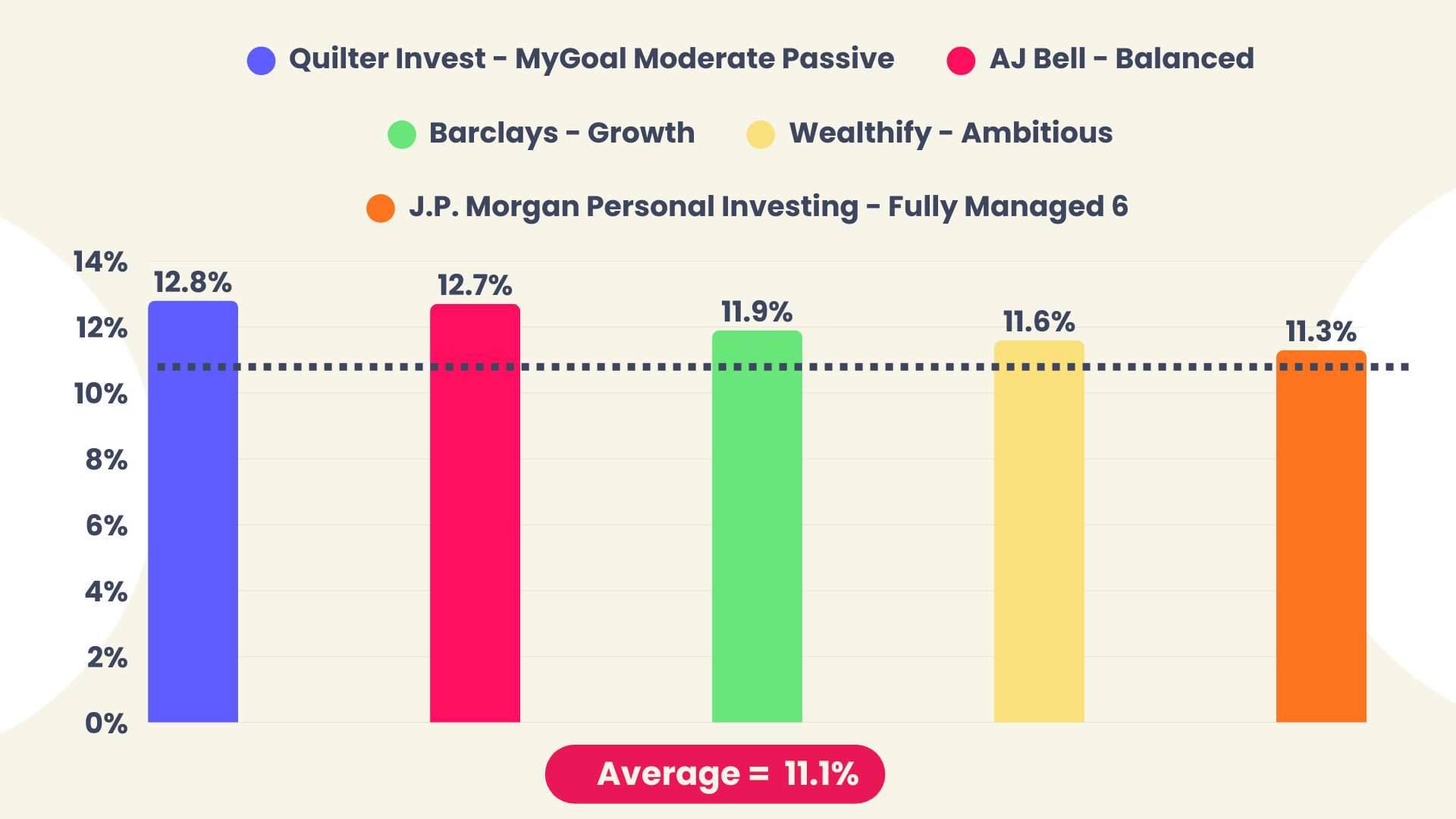
Graph illustrating net returns for one year, covering January 2025 - December 2025, of the top 5 performing ready-made solutions against the average of all of the medium risk funds/portfolios covered in our analysis. Data correct as at 31 December 2025. Returns calculated net of charges. The full fund/portfolio names can be found in the table below.
Which medium risk portfolios delivered the best returns?
AJ Bell, Barclays & Quilter's medium risk solutions are the only portfolios to perform better over 5 years than 3 years, with AJ Bell's balanced fund performing best over this 2 year period.
AJ Bell Balanced was the top medium risk performer over the quarter, rising 3.5%. As with the high risk portfolios, it is vying for the top spot with its MyGoal equivalent. The MyGoal Moderate Passive fund rose 3.4%. Over one year, the top spot is reversed, with the AJ Bell fund up 12.7% and the MyGoal fund up 12.8%.
The average medium risk portfolio returned 2.8% in Q4. The weakest performers over the quarter were the Hargreaves Lansdown Balanced Managed and Aviva Multi-asset Plus II fund, which both returned just 2.3%. These two funds are also bottom of the tables for 2025 as a whole.
How did diversification affect balanced portfolio performance?
The AJ Bell Balanced fund maintains around 60% in equity funds, with the remainder in cash and bonds. The fund has benefited from the diversity of its holdings over the past year, with significant weightings in the FTSE 100, Japan, and emerging markets. This has given it an edge over more US-focused funds as investors have looked beyond the world’s largest market.
Which medium risk portfolios led over 5 years?
The 12-month average return across all medium risk portfolios was 11.1%, with individual solutions ranging from 9.4% - 12.8%. It has been a ‘risk on’ year, when higher risk assets have performed well. As a result, lower risk bond allocations have exerted a drag on multi-asset portfolios. It is notable that the weakest performers among medium risk funds – Halifax Managed Growth 4, Aviva Multi-asset Plus II and Hargreaves Lansdown Balanced Managed also have the lowest equity allocation, ranging from 51% to 54%. In contrast, the MyGoal fund has a 67% allocation to equities.
Over three years, Barclays Growth, Quilter’s MyGoal Moderate Passive, and Vanguard LifeStrategy 60 take the top spots, with returns of 39.9%, 36.3%, and 33.5%, respectively. At the bottom was Charles Stanley Multi Asset Moderate, with a return of 27.9%. This was in spite of being middle of the pack on its equity allocation, at 61%.
Dispersion is wide over five years. Barclays Growth takes the top spot, with a return of 40.8%. That’s double the return from the weakest performer, Charles Stanley Multi-Asset Moderate (20.1%). There is a difference in the annual charges for the two funds. Barclays Growth uses mostly passive funds and is marginally cheaper than the Charles Stanley portfolio, which makes use of active funds[8], [9]. The Barclays fund has also had a higher weighting in the US, with three of its five top holdings (equivalent to 43% of total assets) in US equity trackers. The Charles Stanley fund has just 37% in the US[10].
The Barclays fund has managed to limit the downside in difficult markets, seeing only small losses in the turbulent markets of 2022, while capturing much of the upside in more buoyant conditions. This has been a key factor in its success. The question is whether it can sustain its long-term success as global investors rotate away from the US and diversify their exposure. The group has been keen to emphasise their active management credentials, so they should have the flexibility to adapt to a new environment.
Provider | Fund/Portfolio | Q4 2025 Net Growth | 1-year Net Growth | 3-year Net Growth | 5-year Net Growth |
AJ Bell | Balanced | 3.5% | 12.7% | 27.9% | 35.9% |
Quilter Invest | MyGoal Moderate Passive | 3.4% | 12.8% | 36.3% | 37.3% |
Wealthify | Ambitious | 3.0% | 11.6% | 33.3% | 32.4% |
Charles Stanley | Multi Asset Moderate | 2.9% | 9.9% | 27.9% | 20.1% |
Barclays | Growth | 2.7% | 11.9% | 40.1% | 41.0% |
Vanguard | LifeStrategy 60 | 2.7% | 10.7% | 33.5% | 29.9% |
Halifax | Managed Growth 4 | 2.4% | 11.0% | 31.8% | 28.1% |
Aviva | Multi-asset Plus II | 2.3% | 9.8% | 30.3% | 26.4% |
Hargreaves Lansdown | Balanced Managed | 2.3% | 9.4% | N/A | N/A |
J.P. Morgan Personal Investing | Fully Managed 6 | - | 11.3% | 33.0% | 27.7% |
This table displays performance over multiple timeframes across the past 5 years for a range of investment funds/portfolios. Performance has been calculated net of investment and platform charges. Risk levels have been classified based on Boring Money’s parameters, which can be found in the ‘key terms' and 'methodology' sections below. Performance figures have either come directly from platforms or been estimated using the value of fund assets, assuming frequent rebalancing.


Investing? We’ve got you covered.
Start investing with Scottish Widows and enjoy no account fees until July 2026. Our Ready-Made Investments make it easy to begin with confidence. Choose the level of risk that suits your goals, and we’ll handle the rest. With lower fund charges and expert management, it’s a smart way to make your money work harder without the stress. Whether you’re new to investing or want a convenient option, we’re here to help you take the next step.
Explore Ready-Made Investments today.
Investing carries risk.
FIND OUT MORE
Low Risk Ready-Made Portfolio Performance
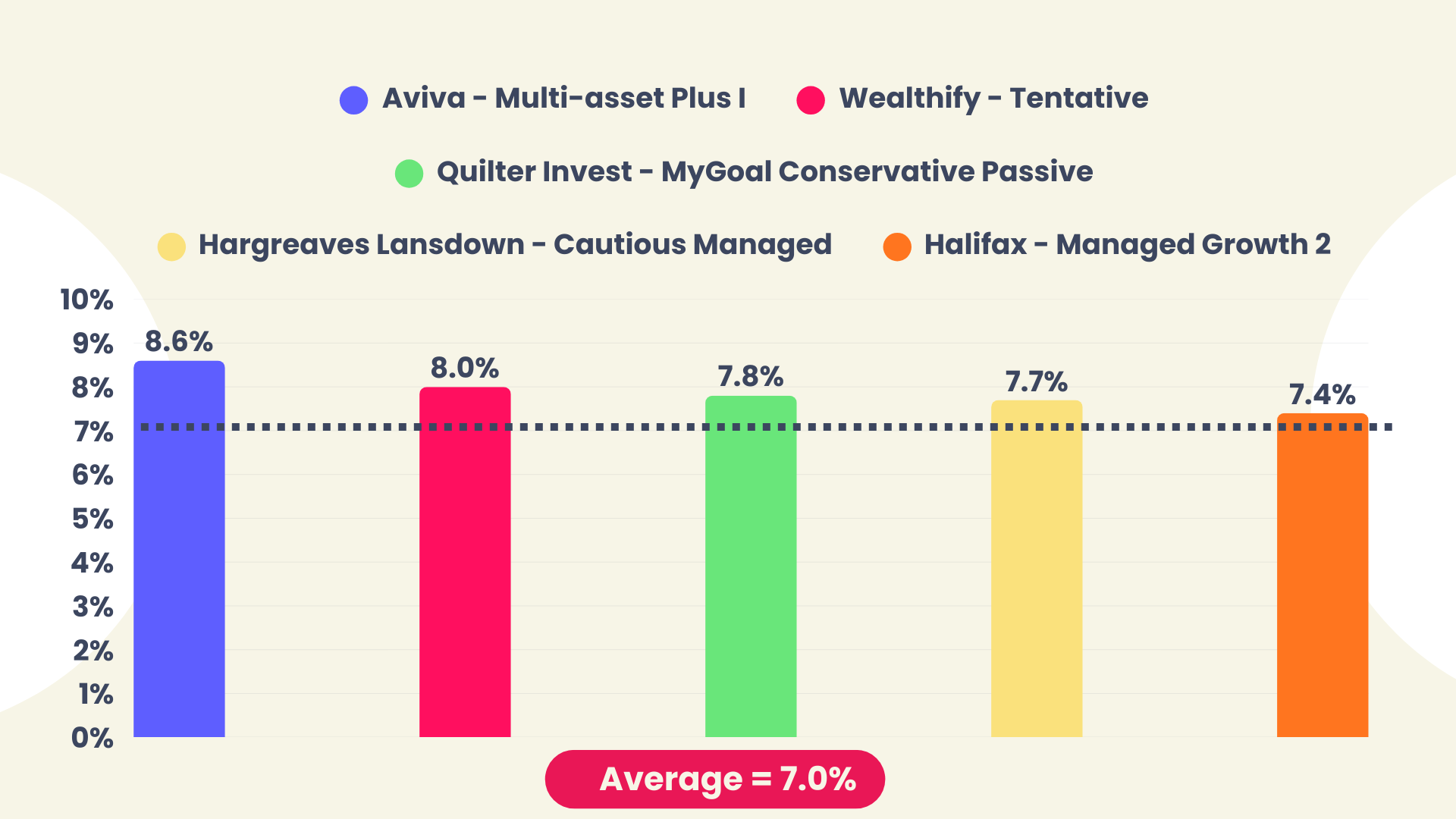
Graph illustrating net returns for one year, covering January 2025 - December 2025, of the top 5 performing ready-made solutions against the average of all of the low risk funds/portfolios covered in our analysis. Data correct as at 31 December 2025. Returns calculated net of charges. The full fund/portfolio names can be found in the table below.
Which low risk portfolios delivered the strongest returns?
Aviva's Multi-asset Plus I fund is the top performer over Q4, 1-year, and 3-years. When looking at a longer time period of 5 years, Hargreaves Lansdown's Cautious Managed fund outperformed the other funds in this category by 4% or higher. All of the low risk solutions this quarter performed better over 3 years than 5 years.
The AJ Bell Cautious fund was the top performer over the quarter with a return of 2.4%, replacing Aviva Multi-asset Plus I at the top of the performance tables. The Aviva fund retains its spot over one and three years, however, while the Hargreaves Lansdown Cautious Managed is the top over five years.
Did low risk portfolios beat cash savings in 2025?
The average low risk portfolio returned 1.7% in the fourth quarter. Returns were more tightly packed for lower risk funds, with just 1.6% between the top and bottom funds. Over a 1-year period, returns spanned from 3.4% (Moneybox Cautious) to 8.6% (Aviva Multi-asset Plus I). The average return from these low risk funds was 7%, with only the Moneybox fund returning less than 6%. Investors have generally outpaced cash by 2-3%.
How do low risk ready-made portfolios compare over different timeframes?
The Aviva fund is neck and neck with the Halifax Managed Growth fund over three years, with the two funds up 22.8% and 22.1%, respectively. Both funds have very low charges - the Aviva fund has ongoing charges of just 0.15%, while the Halifax fund has charges of 0.1%. The Aviva fund currently has around 20% in equity markets, with 51% in fixed income, while cash is 29% of the fund[11]. This is a shift from the previous quarter and suggests some caution on risk assets from the management team.
There is considerable variation in the equity allocation for the various funds. Charles Stanley’s Multi-Asset Cautious fund currently has 38% in equities 8% higher than any other fund. This has helped power stronger performance over the short-term, with the fund third over the quarter and also in third spot over five years.
At the other end of the spectrum, the Barclays Defensive fund holds just 19% in equities. This has held back returns in the short-term, and it is the second weakest performer over five years. Only Vanguard LifeStrategy 20 has performed worse, delivering just 0.2% over five years, though recent performance has been stronger.
The Moneybox Cautious fund also struggled over the quarter, alongside its stablemate, the Moneybox Adventurous fund. Performance has been held back by a large weighting in cash (40%), a smaller weighting in property (5%), and lower weighting in equities (20%). This puts it at the bottom of the league tables over one year as well, having returned just 3.4%. This is 2.9% behind its nearest rival.
However, it may not be possible to predict tomorrow’s winners and losers from the funds that have enjoyed success in 2025. It has been a strong period for riskier assets, and excessive caution has been punished. However, with valuations high and geopolitics becoming more volatile, it may usher in a new era for markets.
Provider | Fund/Portfolio | Q4 2025 Net Growth | 1-year Net Growth | 3-year Net Growth | 5-year Net Growth |
AJ Bell | Cautious | 2.4% | 7.3% | 15.7% | 12.9% |
Quilter Invest | MyGoal Conservative Passive | 2.2% | 7.8% | 20.2% | 9.8% |
Charles Stanley | Multi Asset Cautious | 2.0% | 7.2% | 19.8% | 13.1% |
Wealthify | Tentative | 2.0% | 8.0% | 18.6% | 9.7% |
Vanguard | LifeStrategy 20 | 1.8% | 6.3% | 17.4% | 0.2% |
Aviva | Multi-asset Plus I | 1.7% | 8.6% | 22.8% | 13.6% |
Hargreaves Lansdown | Cautious Managed | 1.7% | 7.7% | 18.5% | 17.8% |
Halifax | Managed Growth 2 | 1.5% | 7.4% | 22.1% | 8.9% |
Barclays | Defensive | 1.4% | 6.8% | 18.9% | 7.2% |
Moneybox | Cautious | 0.8% | 3.4% | 13.7% | 12.8% |
J.P. Morgan Personal Investing | Fully Managed 2 | - | 6.9% | 19.0% | 10.6% |
This table displays performance over multiple timeframes across the past 5 years for a range of investment funds/portfolios. Performance has been calculated net of investment and platform charges. Risk levels have been classified based on Boring Money’s parameters, which can be found in the ‘key terms’ and 'methodology' sections below. Performance figures have either come directly from platforms or been estimated using the value of fund assets, assuming frequent rebalancing.
Disclaimer: Investing is a long-term process, and investment decisions must not be based solely on past performance, especially over short timeframes.
Key terms
Provider
The investment provider offering and managing the fund/portfolio or ready-made solution (see definition below).
Fund/Portfolio
The name of the particular fund/portfolio held on the investment provider’s platform. This will typically include a mixture of cash, bonds, and shares at different proportions depending on your chosen risk level. All funds/portfolios included in this article can also be classified as ready-made solutions - which you can learn more about in our guide here.
Equities
Another name for 'shares' or 'stocks', equities are small slices of a company which investors can buy in order to invest in them. If the company does well, its equities will increase in value. If it doesn't, its equities will fall in value. Read our full guide here for more info.
Bonds
Bonds are like IOUs between you and a company or government. You can lend them money by way of a loan and they pay you interest on this loan. This interest is called the bond 'yield' and the amount differs depending on how risky the loan is perceived to be - that is, how likely the borrower is to be unable to repay it. Bonds are usually considered to be lower risk investments and frequently feature in low and medium risk investment portfolios. You can read more about bonds here.
Risk Level/Category
Boring Money assigns each ready-made solution to a risk level/category based on its equity allocation. For the purpose of this exercise, there are three risk levels. Investments with an equity exposure of under 40% are considered low risk, investments with an equity exposure between 40% - 70% are considered medium risk, and investments with an equity exposure above 70% are considered high risk. You can read more about risk levels and how to determine which is right for you here.
Q4 2025
'4th quarter'. The period between 1 October 2025 and 31 December 2025.
Net Growth
The total growth of a ready-made solution minus charges. Charges include both fees paid for managing the investment and fees paid for using the investment provider’s platform.
Boring Money selects one ready-made solution per provider for each risk category (see definition above). If a provider has more than one suitable ready-made option within a particular risk category, the option selected is the one with an equity allocation closest to a pre-determined exposure level, as shown below:
High risk - 100%
Medium risk - 60%
Low risk - 20%
---
[1] MSCI Europe ex UK Index (EUR)
[2] Moneybox
[3] MSCI World Real Estate Index (USD)
[5] FTSE Russell
[6] Quilter Investors Cirilium Adventurous Passive Portfolio
[8] Barclays
[9] Charles Stanley Multi Asset Moderate A Acc
[10] Hargreaves Lansdown
[11] Aviva




Post a comment:
This is an open discussion and does not represent the views of Boring Money. We want our communities to be welcoming and helpful. Spam, personal attacks and offensive language will not be tolerated. Posts may be deleted and repeat offenders blocked at our discretion.
Your opinion matters
Be the first to comment.