


What Should Investors Do in Volatile Markets? Expert Outlook for 2026 and Beyond
Written by Boring Money
23 April, 2026
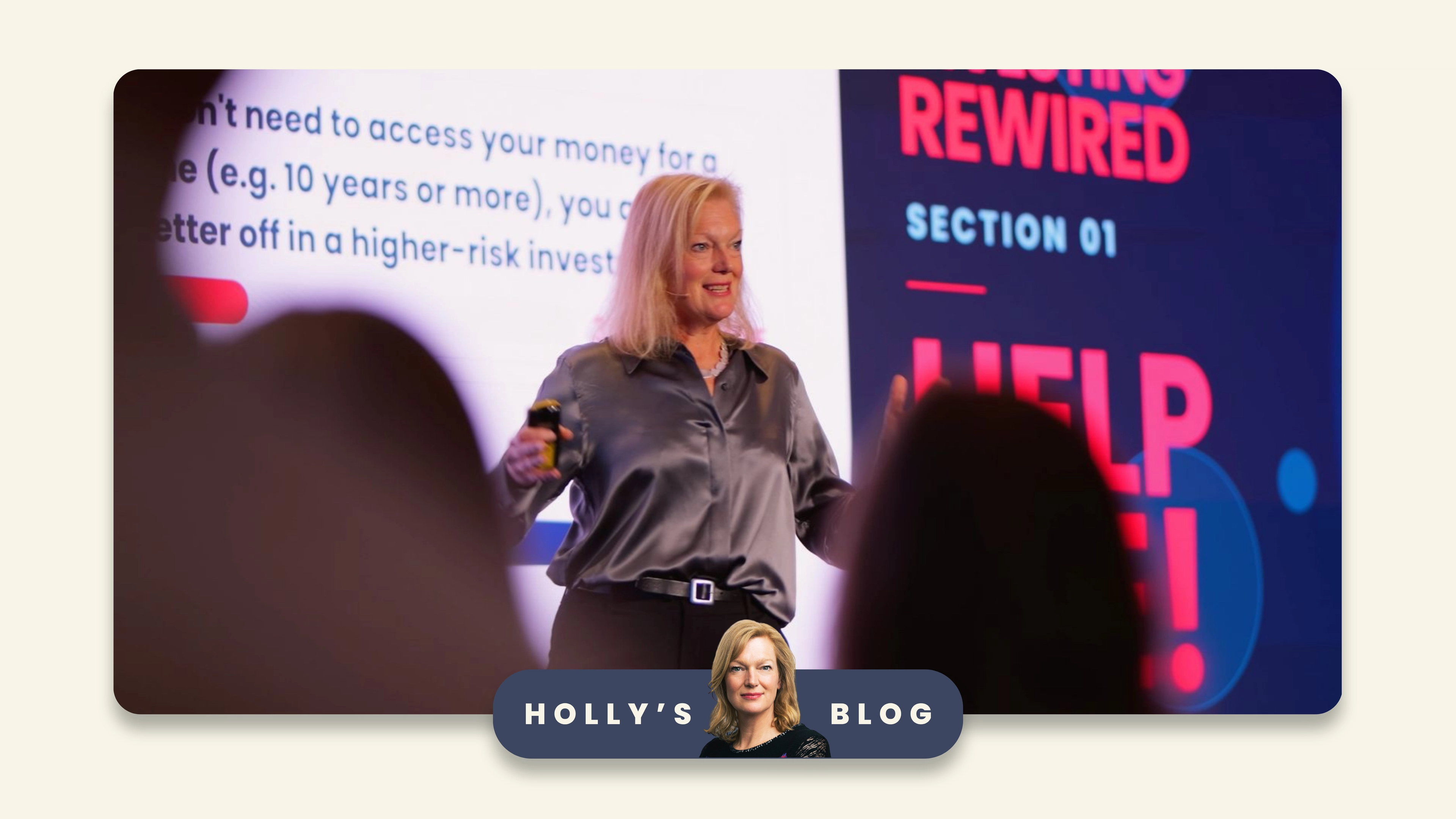
On Tuesday, 21st April we hosted a webinar chaired by Boring Money's Founder & CEO, Holly Mackay, with Marcus Brookes, Chief Investment Officer at Quilter, and Tom Stevenson, Investment Director at Fidelity International. We put reader questions to them on current volatile markets and discussed what investors can expect for the rest of 2026 and into 2027. Watch the full webinar below or read our highlights.
Please note there are some audio quality issues in parts of this recording — we apologise for this. We hope the conversation is still valuable.
What's the general sentiment right now?
Marcus Brookes is broadly positive but acknowledges the uncertainty around today.
Sentiment is genuinely hard to read right now. After a rough 2025, hit by US tariff announcements, markets recovered well towards the end of the year as earnings held up and valuations looked reasonable. But the conflict in Iran has since knocked confidence, pushing oil prices higher and forcing a rethink on interest rate cuts in 2026. The knock-on effect matters beyond the pump: higher oil prices feed through into the cost of transporting goods, which means broader inflation. How long the conflict lasts will be key. The backdrop remains reasonably positive, it's the geopolitical uncertainty that's clouding the picture.

Tom Stevenson pointed to the upcoming earnings season as grounds for cautious optimism, with Q1 profit growth forecasts currently standing at around 13%. History suggests final numbers tend to beat expectations, potentially reaching 15-16%. His main concern is stagflation.
What worries me a little bit more is the longer term impact of the rise in the oil price, the impact that might have on inflation, the impact that in turn might have on interest rates, and then finally, in turn, the impact that might have on economies around the world. If there's one word I was worried about at the moment, it would be stagflation.

Stagflation is a scenario where inflation bites and creeps up at the same time as growth is stalling. Things get more expensive, so consumers buy less, and the economy fizzles out.
Are AI and tech stocks in a bubble, and could they crash?
Marcus pointed out that tech stocks have pulled back from highs in 2025. He also thinks we need a more nuanced view and to dig deeper to find the more interesting tech plays, rather than just see this as a single homogenous sector. He sees AI as a potential tailwind for companies that own their own data, arguing that those who can apply AI to proprietary datasets have a significant competitive advantage, but a potential threat to SaaS providers like Workday and Adobe. He also flagged that the upcoming IPOs of Anthropic, OpenAI and SpaceX could bring £1–3 trillion of new equity to market and investors need to be ready to participate here if they want to.
Tom pointed to the fact that exposure to the US is a big part of investing in tech but:
Korea and Taiwan are both very important in the whole AI supply chain. We’ve seen a very rapid rally in stock markets in April after the fall in March. A lot of that has been driven by technology, both in the US, but also in Korea and Taiwan. It's very important that people don't get carried away by the technology, but equally that they don't walk away from something which frankly is changing the world.
In terms of preferred funds, Tom notes
The biggest risk is being swept up by the latest fad and so overpaying. For that reason, and despite its underperformance during the recent AI boom, I hold the Fidelity Global Technology Fund. It offers a smoother ride than the comparable Polar Capital Global Technology fund (it fell a lot less during the 2022 correction, for example). The Polar fund invests in faster growing and larger (mainly US stocks) while the Fidelity fund is more global and invests in cheaper stocks on average.
(Editor’s note: To be clear, although Tom has access to the whole of market and Fidelity’s platform offer access to hundreds of funds, we should note that Tom works for Fidelity International and so the fund mentioned is an in-house product at Fidelity.)
Is gold still worth buying?
Gold has been a top performer over the last 12 months but has shone slightly less brightly recently, not behaving as such a safe haven in the Iran conflict, where it was more muted than some expected.
Tom noted that gold has historically been a strong portfolio diversifier, partly filling the gap left by bonds, which have become less effective as they have been moving in the same direction as shares. However, he advised caution: gold has run hard, from around £1,600 an ounce three years ago to a peak of £5,500, currently sitting around £4,800.
Gold tends to move in very abrupt upward movements, and then it goes sideways or backwards for many years.
He suggested investors now looking for The process of spreading your investment portfolio across different asset classes, such as partially in shares and partially in bonds, in order to reduce risk.may need to look beyond just gold, either to include other precious metals or to other asset classes such as infrastructure.
As an example, the Fidelity Select list includes the International Public Partnerships Investment Trust.
It invests in mainly UK infrastructure, things like railways, hospitals, schools. And those kinds of investments offer investors a nice income stream. Often that income stream is backed up by contracts with the government…. And the share prices of those infrastructure companies tend to move to a different drumbeat, if you like, from the rest of the stock market, from the rest of the bond market.
Why aren't bonds working as a safe haven anymore?
Bonds have not been behaving as we would expect. Normally they move in different directions to shares. If shares are flying, bonds will not do so well. And vice versa.
Marcus explained the shift in the bond environment. Between 2022 and 2025, falling inflation meant that The return or profit on an investment, usually expressed as a percentage of the total price per year. For example, if the yield on a bond was 5%, this means an investor with £100 in that bond would get £5 in returns per year. came down and prices went up. Loosely speaking when Term used to describe how quickly the prices of goods and services is rising over a period of time. In periods of high inflation, prices are increasing rapidly, whereas low inflation means prices are increasing by only a small amount. falls, so do interest rates. So, bond yields fall because they don’t need to pay such high rates to compete against cash and other places investors might put their money.
This, combined with economic growth powering Another word for shares or stocks., meant that bonds and shares moved in the same (positive) direction. This period of disinflation is over, and we now have inflationary growth that looks set to rise. In an inflationary environment, bonds tend to behave less well.
Marcus is looking to other asset classes in this shorter-term environment where markets are volatile, and bonds are uncertain.
We're trying to find things that make money as markets go down as well, just as a shock absorber in the portfolios. So we're using some of the hedge fund strategies.
These hedge fund strategies include a Janus Henderson long-short fund and a JPMorgan long-short equity fund. Some of these options are opening up to retail investors, not just wholesale buyers like Marcus.
Tom also agrees.
Inflation is a killer for bonds, and the longer the duration, or interest rate sensitivity, of the bond, the more it is impacted by rising prices and interest rates. In an inflationary environment, shorter-dated bond funds look more interesting. The Vanguard Global Short-Term Bond Index Fund lends money to companies where the loan period is short (perhaps only a few years) and benefits from low costs as a passive fund. The AXA Sterling Short Duration Bond Fund is another option: like the Vanguard fund, it lends to companies for short periods, and takes no currency risk as all loans are in sterling.
Are gilts a good alternative to cash savings?
Holly flagged another potentially interesting, tax-efficient diversifier for retail investors: keeping cash in short-term government A gilt is a fixed income bond issued by the UK government. They are so named because, historically, the paper certificates used to issue these bonds had a gilt (gilded) edge. The government issues gilts in order to fund public spending.. These are effectively IOUs we make to the UK Government. We know they mature at face value (£100), so we can see how much we will make if we hold them until they mature.
She cited an example of a gilt maturing in January 2028, currently trading at just over £93. This will be worth £100 when it matures. So we’d get £7 back in this timeframe which translates to a yield of about 4%, with largely tax-free capital gains. This is a straightforward and tax-efficient option that some investors sitting on cash may wish to consider, particularly In the UK, the first £12,570 of your income is tax-free, covered by the Personal Allowance. After that, earnings up to £50,270 are taxed at 20% — the basic rate. Income between £50,271 and £125,140 falls into the higher rate band and is taxed at 40%. Anything above £125,140 is taxed at the additional rate of 45%. liable for paying tax on interest made in mainstream cash products.
Is the 60/40 portfolio rule still relevant for retirees?
The 60/40 rule is a traditional recommended split between equities and bonds, particularly for older investors approaching or in retirement.
Holly queried whether this is still an appropriate rule of thumb. She asked, “How do retirees balance that mix between growth, but also preservation of capital for when things get a bit iffy like they have this year?”
Tom’s view was that this progressively more cautious approach used to work in a world where people retired and bought an annuity.
Increasingly, people are using their pension pots to draw an income during their retirement, and over that long period of time, inflation becomes a real risk. A revised framework of 60% equities, 20% bonds, and 20% in other diversifiers such as gold, infrastructure, property and cash is a better way for investors to think about this today. Maybe 60/40 is too simplistic a way of balancing your portfolio.
60/40 works in a disinflationary environment. But in this slightly different environment, I think you need something more.
He conceded that bonds still have a role, but you need to be specific about which type: government, corporate, high yield, or emerging market debt - depending on your view of the macro environment.
How should investors diversify in today's market?
Tom pointed specifically to infrastructure as an interesting diversifier, naming the International Public Partnerships Investment Trust (INPP) from Fidelity's Select 50 list.
We like the reliable income of infrastructure funds. International Public Partnerships offers not only a high dividend but one which has grown every year since 2006. The trust also trades at a big discount to the value of its underlying assets. Investors looking for a more global infrastructure play (INPP is mainly UK focused) might consider the First Sentier Global Listed Infrastructure Fund.
Another vehicle which serves up diversification is a A term used to describe a product or portfolio that contains more than one type of asset class - e.g. shares and property., especially one focused on generating returns in a variety of market conditions (an absolute return). Tom suggests Pyrford Global Total Return:
Very conservatively managed and has delivered a smooth ride over time.
Marcus echoed the case for diversifiers and pointed to emerging market debt, particularly in China, as an example of how bonds are a broad asset class with lots of choices.
If you think we've got good backdrop for growth you might consider corporate bonds and maybe even high yield – although high yield looks a little bit sticky at the moment, so just watch out for that. But emerging market debt, you might even think, well, there are some really dynamic economies really starting to emerge now.
China looks quite sensible in the way they’re approaching their fiscal and monetary policy. They’ve also got a lot of AI going on. They are maintaining currency stability and investing heavily in renewables, which provides some buffer against oil price rises.
In terms of other emerging markets, he pointed out that Brazil – a net oil exporter – has had a good year.
Which geographical regions look most attractive to invest in?
Marcus flagged that Quilter had been underweight in US equities for a couple of years due to tech valuations but is now moving to close that at a more neutral position.
The US equity market is starting to look a lot more investable than it was a year ago.
We have been underweighting the US for the last couple of years, basically because we thought tech was overvalued. But the tech valuations coming down is actually getting us quite interested. So, from a valuation perspective, the US looks interesting from a geopolitical point of view.
He also pointed to a supportive backdrop from the incoming The central bank of the United States, responsible for setting American interest rates and managing the money supply. Its decisions ripple far beyond US borders — when the Fed raises or cuts rates, it affects the dollar, global borrowing costs, and asset prices from bonds to gold worldwide. Often shortened to "the Fed." governor Kevin Walsh, who is seen as more inclined to cut rates.
On emerging markets, Marcus was enthusiastic about the medium-term prospects for Japan, India and China. He was extremely positive about Japan and their new growth-focused government, but urged caution on India specifically, as several major family-run conglomerates which dominate markets can have other motivators driving them. He encouraged prospective investors to check that any gains in shareholder value actually flow through to them, rather than being captured by those in control.
He cautioned against using Investment funds that automatically follow a market index or set of rules without a manager actively picking investments. They aim to match the performance of their chosen benchmark rather than trying to beat it, typically offering lower fees than actively managed funds. in emerging markets:
Active managers tend to do really well in emerging markets - there are thousands of companies to choose from. [It's important to have] analysts on the ground who are talking to the management.
He also highlighted governance questions as a reason to favour more investigative active funds. Marcus uses Allspring for emerging markets exposure and likes JP Morgan’s India fund as a solid active option.
Tom is extremely positive about Japan.
It has a new government, a government which is keen to invest in the growth of the economy.
The economy is opening up, M&A is becoming easier, and the yen has depreciated so there is a competitive advantage for exports.
What is the stock market outlook for the rest of 2026?
Marcus is positive.
Every year that I've been in the markets, there's been something of this sort of nature going on. I’m not downplaying it at all, but 1994 was Mexico going bust, ‘97 was Thailand going bust, ‘98 was Russia going bust. All of these things seemed existential at the time, but actually, companies just got on and did what they had to do.
And I think that's kind of where we are at the moment.
I don't think necessarily today's a brilliant time to get going, but it's not a brilliant time to come out of the market either, because one of the lessons I've learned from my career is no one ever rings a bell to buy back in. Most people like buying things that are going up, and they sell things that are going down, and investor psychologists have to do the opposite”.
Tom is also cautiously optimistic.
Investors have enjoyed a powerful short term bull market since the 2022 correction and a longer-term rising market going back as far as the 2008 financial crisis. Valuations are no longer obviously cheap. That argues for caution.
But the history of stock markets has been described as the Triumph of the Optimists. Investing has rewarded those who can take a long-term view and stick with the market through its inevitable ups and downs. Strong earnings growth has already reduced high valuations to much more reasonable levels and profits are forecast to continue rising throughout the next couple of years. Diversification and steady investment through the cycle are the best protection against market volatility.”




Post a comment:
This is an open discussion and does not represent the views of Boring Money. We want our communities to be welcoming and helpful. Spam, personal attacks and offensive language will not be tolerated. Posts may be deleted and repeat offenders blocked at our discretion.
Your opinion matters
This was a great feature, clearly explained without dumbing down. Also good to hear some recommendations. Look forward to more of these!!