




What's the best way to save for retirement in the UK?
⏲️ 45 minutes 📚 6 Lessons
In this course you will learn:
✔ How much money you need for retirement
✔ How the different types of pension work
✔ How much you're on track to have by the time you retire
✔ Some handy tips to boost your retirement savings
Welcome to our course
For many of us, saving for retirement takes a whole lifetime and can be a huge muddle of numbers, rules and allowances to get your head around. What’s more, it can feel like you’re blindly tucking money away for the future without really understanding if it’s going to be enough to afford the retirement you’ve been dreaming of.
We’re here to help. With this simple, 6-step course, we’ll teach you how to work out how much money you need to save for your retirement, how the 3 types of pension - State, Workplace and Personal - work and how to use them to your advantage, and we’ll share some helpful tips to top up your pension no matter where you are on your retirement planning journey.
Whether you’re just starting out or you’re looking for ways to boost your existing savings, we’ll help you get your ducks in a row.
Welcome to the first lesson in our 'How to save for the retirement you want' course! In this lesson, we're going to cut to the chase and start by tackling the big question on all our minds – how much do you really need to save for your retirement?
How much do you need to retire?
The amount of money you need when you’re retired depends on the sort of lifestyle you’re going to have. For example, someone who wants to go on two 6-week luxury cruises every year probably needs more income than someone who’s staying at home to spend time with the grandkids!
If you’re not sure what you’re planning to do with your time once you retire, Pensions UK have a handy guide to how much money you might need depending on your retirement lifestyle called the 'Retirement Living Standards'.
One of the biggest questions we all have about retirement is precisely how much do we need every year to afford the lifestyle we want? So the very first step in planning your retirement is to work out that magic number. Pensions UK have a really helpful guide which provides some useful rules of thumb.

Tier | Singles Annual Income | Couples Annual Income |
Minimum | £13,900 | £22,500 |
Moderate | £32,700 | £45,400 |
Comfortable | £45,400 | £62,700 |
Tier | Singles Annual Income | Couples Annual Income |
Minimum | £13,900 | £22,500 |
Moderate | £32,700 | £45,400 |
Comfortable | £45,400 | £62,700 |
Working out which of the above tiers you fit into is really down to you and your unique circumstances. After all, your idea of the ‘perfect’ retirement could look very different from someone else’s!
Now remember, the full new State Pension is currently only about £241.3 a week - that’s £12,547 a year - and that's well below even the minimum income that Pensions UK think we're going to need. And if you have gaps in your working life or a broken National Insurance record, you might not be eligible for that full amount anyway. So once you know how much you need every year to afford the retirement you want, the next step is to work out how much your State Pension will go towards covering this. We can check our State Pension forecast online to find out how much we're in line for.
It’s a good idea to take a little while to think about what you envision doing with your time once you finish work. Make a note of any activities you’d like to do – e.g. two overseas holidays per year – and use these to get a rough idea of which of the three retirement tiers you think is most appropriate for you.
Thank you for completing Lesson 1!ㅤ
Next up: Check your State Pension forecastㅤㅤ
Welcome to the second lesson in our 'How to save for the retirement you want' course! In this lesson, we'll explain everything you need to know about the State Pension, including eligibility rules and how much you could get.
What is the State Pension?
You can get an income from the state after you’ve retired - this is called your State Pension. It's there to ensure we all have a basic amount of money to support us in our old age - the bread and butter of your retirement income, if you like.
The amount of State Pension you can get – your State Pension ‘entitlement’ - is linked to your National Insurance (NI) contribution record. That is, you’ll only receive the full amount of State Pension if you’ve paid NI for a certain number of years – for most of us, it’s a whopping 35!
The good news is that they don't all have to be consecutive. As long as you’ve paid NI for the specified number of years, you’ll be eligible for the full State Pension amount. But how much is it, and how many years of NI contributions do you need to get it?
Find out your State Pension age here!
How much is the State Pension?
There are two types of State Pension and the amount you can get from each one differs depending on whether you're a man or a woman and when you were born.
New State Pension
If you're a man born on or after 6 April 1951 or a woman born on or after 6 April 1953, you’re entitled to the new State Pension. For the 2026-27 tax year, the full new State Pension is £241.3 per week or £12,547 a year.
You must have paid NI contributions for a minimum of 10 years to qualify for any new State Pension at all. And you must have 35 years of contributions under your belt to qualify for the full amount!
If you have fewer than the minimum number of 35 qualifying years, the amount of new State Pension you receive will be less than the full £241.3 per week.
Jane was born in 1960. She started paying NI contributions when she got her first job in 1980. She worked until 1985 when she took a 3 year break to have a child. She went back to work in 1988. She then took a 2 year break in 1992 to have another child. She went back to work in 1994 and has been working ever since.
As of 2024, Jane has been working for 44 years. However, she has taken a total of 5 years out of work to raise her children, meaning she didn’t pay any NI contributions during this time. So 44 – 5 = 39, and despite the time Jane took off work, she has still paid more than the minimum 35 qualifying years, so she is now eligible to receive the full amount of State Pension when she reaches state retirement age (more on this below).
Basic State Pension
If you’re a man born before 6 April 1951 or a woman born before 6 April 1953, you’re entitled to the basic State Pension. The rules for this - and the amount you can get - are a bit different. You can read more about it and whether or not you're eligible on the gov.uk website here.
What is the State Pension age?
The State Pension age is the minimum age you must be before you’re able to receive your State Pension. It’s currently 66, but the government plans to increase it to 67 between 2026 and 2028, and 68 between 2044 and 2046. It will most likely continue to rise even beyond this.
Check how much State Pension you will get
You can find out how much State Pension you’re eligible to receive on the gov.uk website. Enter a few of your personal details and it will tell you:
- How much State Pension you will get
- When you can get your first State Pension payments
- How to increase your State Pension entitlement (if you can)
Check your State Pension forecast
Thank you for completing Lesson 2!
Next up: Pay attention to your Workplace Pension
Welcome to the third lesson in our 'How to save for the retirement you want' course! In this lesson, we'll explain everything you need to know about Workplace Pensions, including how they work and the rules around contributions.
How does a Workplace Pension work?
The State Pension is the bread and butter of your retirement income, but many of us also have a Workplace Pension (or two, or three...!) ticking along in the background – depending on how many jobs you’ve had.
These can grow to a sizable amount over the course of a working lifetime, and as you can often adjust how much you contribute and what it’s invested in, you typically get more control over how much it’s worth when you finally retire compared to a State Pension.
- A Workplace Pension is a Defined Contribution pension your employer sets up for you automatically. By law, at least 8% of your earnings must go in each month - 5% from you, 3% from your employer.
- If you’re paying Income Tax on top of a Workplace Pension, the government will make an extra contribution known as tax relief.
- Since auto-enrolment rules came into force in 2019, most UK employees are enrolled into a Workplace Pension by default. You can opt out if you want to, but you'd be turning down free money from your employer and the government.
- Your Workplace Pension is locked away until your 55-years-old.
- You can check exactly how much you and your employer are contributing by asking your HR or payroll team directly.
How Workplace Pensions work if you earn £2,500 a month:
- You contribute 5% = £125/month.
- Your employer contributes 3% = £75/month.
- Depending on your usual rate of income, the government will give you a tax relief. For instance, if you pay 20% in Income Tax, you will receive a 20% tax relief into your pension, which is £25 a month.
- This brings you monthly savings into your contribution to be £225 a month.
Learn more about Workplace Pensions in our handy guide
How do you check how much is in your Workplace Pension?
You can find out about your Workplace Pension contributions – and your employer’s - in the paperwork that you would have signed when you first started your job. If you’re not sure where that’s ended up, you can also contact your employer directly. They will be able to provide you with documentation about your scheme and tell you how much they’re currently contributing to your pot if you’ve misplaced your first copy.
Your Workplace Pension provider will also send you a statement every year telling you how much is in your pot to date, and in this annual statement you’ll typically find an estimate of how much you’ll have in your pot when you retire. If not, you can request an estimate from your provider by using the contact details provided in the statement.
What is your Workplace Pension actually invested in?
Most Workplace Pension schemes have a default fund for all employees that you’re invested in automatically, which will probably be OK for most people. However, this might not be clear from the outset so it helps to find out from your employer or pension provider exactly what this is so you can do some background research into where your money is really going.
In addition, the default fund isn’t necessarily set in stone. You might find – depending on where you are in your retirement journey – that you would prefer to invest your Workplace Pension in something else. Perhaps you want to increase your risk exposure if you’ve got lots of time before you need to access your funds, or you’d like to shift your money into a more ethical or sustainable fund that’s more aligned with your personal values.
There is often some wiggle-room to adjust the fund you’re invested in, though you may have to stick with the same provider that your employer has selected. But remember, if you don’t ask, you don’t get! Contact your employer to find out how much flexibility you’ve got. There’s no harm in asking – it's your pension after all.
Can you increase your Workplace Pension contributions?
Yes! There’s no lifetime limit on the amount you can put in your Workplace Pension, although there is an annual one. Your employer might not contribute beyond the mandatory 3%, but you’re free to put in up to £60,000 per year by yourself – the automatic 5% isn’t set in stone.
If you decide you want to top up your pension, the easiest way to go about it is to contact your employer directly and see if they can set it up on your behalf. They might offer to increase their contributions too! You’ll continue to get the same amount of tax relief that you were getting before.
Just bear in mind the annual limit on the amount you can contribute to a Workplace Pension, which is currently £60,000. That’s more than many of us will be able to save anyway, but something to think about if you’re a higher earner!
Get to know Workplace Pensions in our exclusive Hub
Thank you for completing Lesson 3!
Next up: Why you should open a Private Pension
Welcome to the fourth lesson in our 'How to save for the retirement you want' course! In this lesson, we'll explain everything you need to know about Personal Pensions - also called 'SIPPs' - from allowances to the best providers.
What is a SIPP?
A SIPP, or a Self-Invested Personal Pension, works similarly to a Workplace Pension, but instead of your employer choosing which provider and fund you’re invested in, it’s up to you to decide what to do with your money.
Even with a State Pension and Workplace Pension under your belt, you might find that you need a little bit more in your retirement savings pot to afford the lifestyle you’re aiming for. Particularly if you’ve decided that you’re aiming for Pension UK's definition of a ‘comfortable’ retirement. So you might need to find other ways to boost your retirement income. That’s where a Personal Pension comes in.
There are dozens of SIPP providers on the market and there’s a huge range of investments you can select from too. Shares, funds, bonds, property... the mix and proportion of investments in your SIPP is down to which products and provider you choose.
To understand SIPPs, you have to get rid of this idea that a pension is a complete thing in its own right. A pension is just a container with its own set of tax rules and access rules about the money inside it. What actually goes into this container is not necessarily an opaque decision which you hand off to some distant expert to handle for you - as it can sometimes feel with a Workplace Pension. Every time you put some cash into the SIPP, you get to decide what investments to buy with your cash, and therefore you control how your retirement savings are deployed.
Find out more about SIPPs in our essential guide
Why should I open a SIPP?
- When you pay into a SIPP, the government adds tax relief on top - for basic rate taxpayers, every 80p you contribute becomes £1. Higher rate taxpayers get the same 20p top-up upfront, then can claim back more through their tax return, bringing their real cost down to 60p per £1.
How the tax relief works:
- Basic rate taxpayers: Pay in 80p → government adds 20p → you get £1 in your pension
- Higher rate taxpayers: Pay in 80p → government adds 20p automatically, plus you can claim back a further 20p via your tax return → £1 in your pension effectively costs you 60p
Another key reason to open a SIPP:
- Pensions sit outside your estate for Inheritance Tax purposes - money in a SIPP isn't taxed when you pass it on, unlike most other savings and investments.
The number one incentive is this bonus money from the government – which they basically give you to lessen the pain of millions of broke 100-year-olds to sort out! This extra cash - actually ‘tax relief’ - is matched to your usual rate of Income Tax. So basic rate taxpayers get £20 for every £80 they put in a SIPP and higher rate taxpayers can claim a further £20 back to add to their pot.
Couple this with any other retirement savings you’ve accrued in State Pension and Workplace Pensions, and you’re much more likely to be able to afford the post-work lifestyle you’re after.
And importantly, if you’re self-employed, a SIPP is a great substitute for a Workplace Pension – so you don’t have to sacrifice your retirement savings just because you’ve got an entrepreneurial spirit!
Find the best SIPP provider for you
There are dozens of SIPP providers out there to choose from and it can be a really daunting task trying to find the right one! That’s why we’re here to help. You can head to our SIPP compare tables to see the providers that we – and Boring Money readers – think are the best on the market, and you can compare fees, investment choice and browse the latest customer reviews too.
Compare SIPP providers
Thank you for completing Lesson 4!
Next up: Make your retirement cocktail
Welcome to the fifth lesson in our 'How to save for the retirement you want' course! In this lesson, we'll share with you a handy worksheet to fill in so you can calculate how much money you're on track to have when you retire.
How much money will you have when you retire?
Congrats! You’ve got a rough idea of how much money you need for your ideal retirement and you’ve learned about the 3 different types of pension that can help you save up for it. But how can you make sure you definitely have enough?
It can be helpful to think of your retirement income like a cocktail, made up of individual shots of different things. The shots are your State Pension, Workplace Pensions, SIPP and any other regular sources of income you’re going to have once you’ve retired (such as rent if you’re a landlord). Together they make up the full cocktail that you’ll be sipping on as you put your feet up and enjoy your hard-won rest.
To get a better sense of whether you’re on track for that ideal retirement – or if you need to switch up your strategy and save more – we've put together a helpful worksheet so you can calculate how much retirement income you’re likely to have each year. We've used 22 as an example of how long you might reasonably expect to live after you retire.*
This worksheet will help you to identify the main sources of your potential income in retirement and give you an idea of what this all looks like in terms of an annual figure. It can also help you identify where you have any gaps, so you can get started on addressing that too.
We suggest you print out the worksheet, grab a cup of tea and a calculator, and gather up any relevant pension paperwork before you get started!
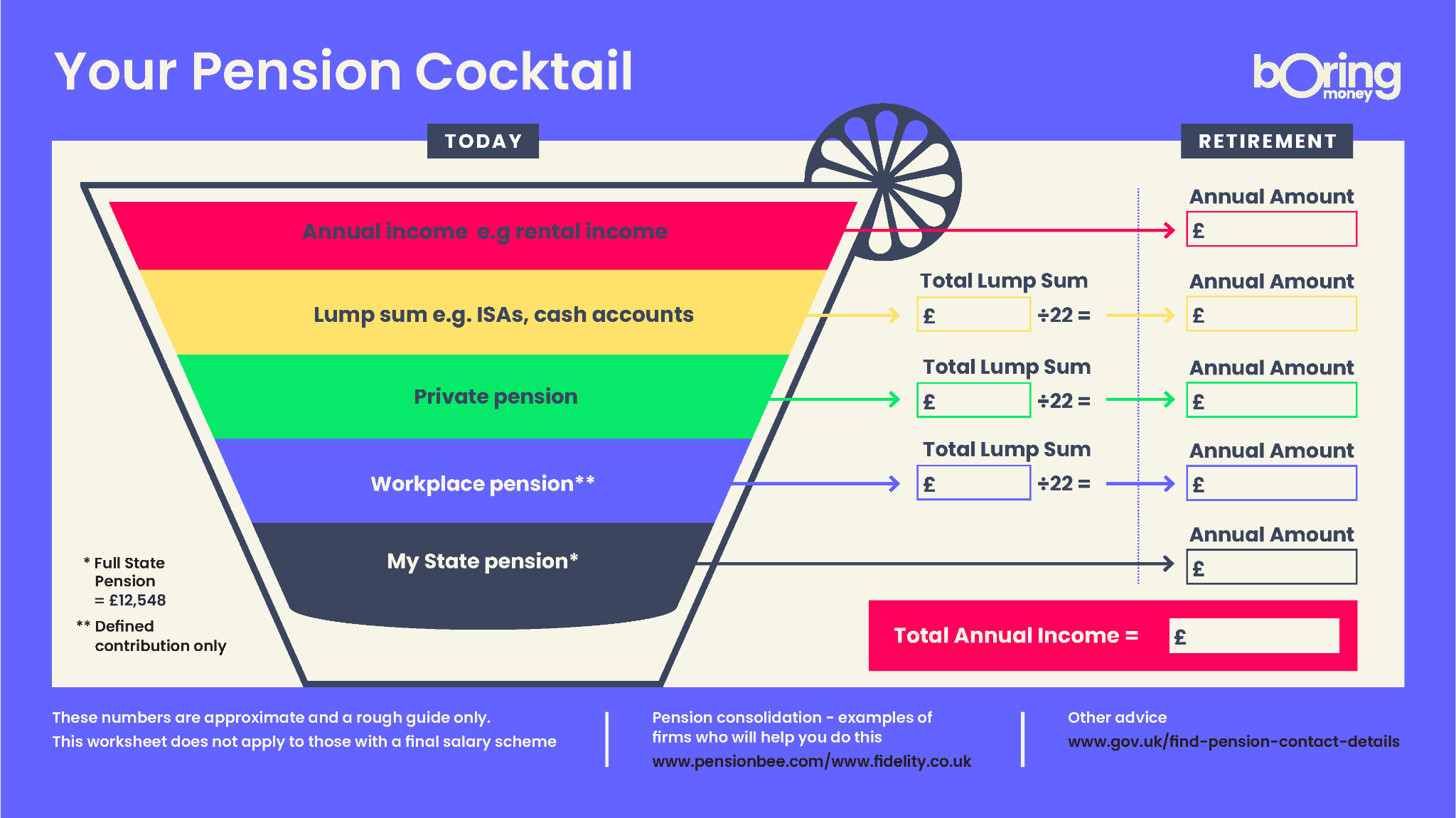
*These numbers are an approximate guide and should be treated as a rule of thumb only.
PENSION COCKTAIL WORKSHEET
Thank you for completing Lesson 5!
Next up: 3 ways to boost your retirement savings
Welcome to the sixth lesson in our 'How to save for the retirement you want' course! In this lesson, we'll show you a handful of helpful tips from a finance expert to help you boost your retirement savings.
How to bridge the gap
OK, so you’ve worked out your end goal. You’ve got your head around what you have today. But what if there’s still a gap? How can you make sure you have enough money set aside to afford the sort of retirement you want? Holly gets some tips from Chartered Financial Planner and all-round wise owl Sam Secomb on 3 things you can do to make your pension grow.
Helpful stuff! Here’s a summary of Sam’s top 3 tips to help you boost your pension savings and get you on track for that ideal retirement.
1. Increase your pension contributions
You can pay money directly into your SIPP (if you’ve got one!) and get a 20% bonus from the government on the way in! For example’s sake, you could repurpose some money from another account - such as a Stocks & Shares ISA or a General Investment Account - and scoop up that bonus at the same time by making additional pension contributions.
2. Be careful about too much cash
Many people play it too safe with their pensions and rely heavily on cash, which actually goes backwards in value over the long term. Remember the hormone analogy - equities are like testosterone because they make things grow! Paying attention to what your pension is invested in can make a huge difference to how much you’ll have in your pot when the time comes to use it.
3. Work longer, even if it’s only part-time
Choosing to work past the age of retirement can be a very fulfilling endeavour, and it doesn’t have to be full-time! It won’t work for everyone, but if you can, getting a part-time role can keep some money trickling in but still allow you the time to indulge in your hobbies - best of both worlds!
5 top tips to help you prepare for retirement
Thank you for completing Lesson 6!
Next up: Time to review!
So there you have it! You’ve learned all about how to save for your retirement, from working out how much you need to understanding how to use the three different types of pension to your advantage.
We hope you’ve found this course helpful – wherever you are on your retirement saving journey. Help us to make our courses even better by telling us how confident you feel about saving for retirement now that you've completed 'How to save for the retirement you want'.