




How do I consolidate my pension? A step-by-step guide
Written by Boring Money
29 Sep, 2026
Are you not sure how many pensions you have or how to trace them? Do you have lots of smaller pension pots floating in the ether from old jobs? Did you know that you can round them up and keep them all together? Introducing pension consolidation! The handy way of keeping all your pensions up in one, single, easy-to-follow place.

In this guide, we’ll walk you through the basics of pension consolidation, the pros and cons and some frequently asked questions to help you understand more and arm you with the knowledge to make the right decision. Plus, we asked experts Graham Wells from GroWiser Financial Coaching and Matthew Spence from Spence Financial to weigh in with their thoughts. Let's dig in.
What is pension consolidation?
Pension consolidation is when you combine several different pensions together into a single pot. Many people have lost or forgotten about pensions from previous jobs, or you may just have quite a few that you’re aware of but find it hard to keep track of them all separately.
There are millions of people in the UK who are juggling multiple pensions. In fact, Boring Money’s Pension Report 2025 found that 46% of people aged over 55 and 31% of 25 to 34-year-olds hold two or more pensions.
This is where pension consolidation can help you to have everything under one roof – so you have less paperwork to wade through when you want to check how your pot (or ‘fund’) is doing. However, despite the number of Brits with multiple pension pots, our research shows that only 3 in 10 pension holders have consolidated to date. So if you’re one of the 7 in 10 who haven’t, how do you decide if you should consolidate your pension and how do you do it?
Why should I consolidate my pension?
Your pension savings can be worth an awful lot of money – individuals aged over 55 have £151,000 in their pot – so it makes sense that you want to consider all your options and think carefully before committing to moving anything around.
It’s more convenient
Obviously, managing a single pension is bound to be easier than managing several pensions. Combining them can make it easier to keep track of how much you’re saving and review the performance of your investments over time. This means less rummaging around for paperwork or phone numbers to contact different providers! It also makes things easier and quicker when it’s time to start taking from your pension savings, so if pension drawdown looks like the route you’re going to take, consolidation is a bit of a no-brainer.
Consolidating your pension can offer advantages like a streamlined structure, potential fee reduction, simplified monitoring of retirement savings, and estate planning convenience.

Could save you money
Sometimes pension consolidation can save you money. Each pension you own with a different provider will have different management fees. If you transfer your savings to a provider with lower fees, for example, over time you could save yourself money. However, pay close attention, as some providers charge exit fees which could eat away at the savings you’re making by transferring. And of course, you want to avoid transferring your pensions to a provider which charges even more!
It’s quite possible to save money by consolidating your pensions, but remember, it may also be possible to save money simply by making changes to fund choices within your existing plans. The fees you pay can usually be broken down into the annual percentage charge for individual investment funds and also a platform charge for the firm that manages your pension. Sometimes, these two fees are combined into an ‘all inclusive’ fee. It’s important to understand what you’re paying on each of your existing pension plans, before making a comparison with the plan you’d like to keep. This may all take a bit of research, but it can be well worth the effort. There’s a huge bandwidth of charges between different pension funds and providers, so a saving of just 0.5% per year can make a big difference in the long term!

May get better growth
Past performance is never a guarantee of future success. However, you may have one or two pensions which have been performing significantly worse than others over a long period of time. And equally, you may have a couple that have consistently earned you better returns than the rest. Look for consistency over time; If you have one or more funds which are persistently underperforming, you may find that you can get better growth by transferring to a different fund with a different provider.
Consolidating pensions might offer better growth opportunities if the new plan has better investment options and lower fees. Nevertheless, each person's situation is unique. Initially, you might want to assess your investment risk profile and your tolerance for financial loss, considering the time left until your envisioned retirement date. If your selected retirement date is just around the corner and you are not comfortable with short-term losses, consolidating your pension is unlikely to offer better growth without exposing you to excessive risk. Alternatively, if your pension investment horizon extends over many years, and you are open to higher levels of risk, consolidation could potentially lead to better growth, although of course this cannot be guaranteed.
Can be quick and easy
Pension consolidation is getting easier and easier and there are now several providers on the market which make it quick and simple to do. PensionBee, for example, is a popular pension consolidation platform which allows you to combine your previous pensions into a new fund for free – so it doesn’t need to be expensive and you can get the process started in just a few clicks.
The good news is that, nowadays, it’s easier than ever to tackle this job. Some of the more modern pension providers focus their marketing specifically on the ease of consolidating pensions into their products. If you’re currently in employment, it can often make sense to consolidate into your current workplace scheme and that could mean a bit more effort on your part, but again, worth it if the charges are particularly low and the fund choice is suitable. In some cases, the value or the complexity of your retirement planning may mean it's worth seeking regulated financial advice. This will add another layer of cost, of course, but can be money well spent to avoid making expensive errors, or even to save time on research and administration. Also be aware that defined benefit, or final salary, pensions with a cash equivalent transfer value (CETV) of more than £30,000 cannot be transferred without regulated financial advice.
When should I not consolidate my pension?
Your provider’s exit fees are expensive
Although transferring your pensions to a better-performing pot could get you more growth, keep an eye out for exit fees when transferring your pots. Some providers charge a fee, which can be significant, when you remove your funds from their account. 2022 research from Citizens Advice found that 41% of people accessing their pensions have been charged for doing so, with the average ‘exit’ or ‘transfer’ fee being around £1,577. Those with smaller pots of £20,000 or less ended up paying around 10% of the value of their pot in exit fees! If your provider has hefty charges and your pot is relatively small, it may be worth keeping it where it is rather than incurring the fee for consolidating.
You might lose guarantees from a defined benefit scheme
If you’ve got a A type of workplace pension that promises to pay you a guaranteed income for life when you retire. The amount you get is usually based on your salary, how long you’ve worked for the employer, and is linked to inflation. This type of pension is now quite rare outside of the public sector. pension, you may not be able to consolidate into a defined contribution pot – and if you are, you may end up losing some of the guarantees that come with your plan. Take the time to review the paperwork on this, as consolidation may not make the most sense for you if you have to sacrifice some attractive benefits in the process, such as a guaranteed annuity rate. If you’re feeling torn, it’s a good idea to consider getting financial advice to help you decide on the best course of action for you. An adviser can assist you in weighing up the pros and cons to reach a decision.
Your employer is still paying into a workplace pension
If you’ve got a workplace pension which your employer is currently paying into, transferring it means that they will no longer be able to contribute – so you could miss out on extra savings. In this case it may make more sense to leave an active pension pot alone and focus instead on consolidating any others which are no longer being contributed to.
What are the pros and cons of pension consolidation?
The table below breaks the basic pros and cons of combining your pensions. Remember however that deciding whether or not to consolidate is highly dependent on your unique circumstances, so if in doubt, it’s a sensible idea to get in touch with a financial adviser.
Finding a financial adviser
It’s important to find the adviser who’s right for you. VouchedFor can match you with an adviser according to advice type and location – or you can search for an adviser to check their background.
- Verified reviewers. Reviews come from checked clients — VouchedFor confirms each reviewer’s identity, and doesn’t edit or remove negative reviews.
- Independently vetted. VouchedFor confirms each adviser is authorised by the appropriate regulator, along with their fees and qualifications.
- A follow-up afterwards. VouchedFor check back in to see whether the advice met your needs.
500,000+ client reviews
4.8 / 5 average adviser rating
If you’re thinking of consolidating your pensions, Matthew says:
First and foremost, everyone's situation is unique, and what proves beneficial for one person may not necessarily apply to someone else. And this is true when combining pensions. Take a step back and reflect on your financial objectives, your tolerance for financial loss, and the level of risk you are willing to embrace. Assess factors such as anticipated retirement expenses to establish the necessary income for a comfortable retirement. I would also consider using cashflow modelling, which - when employed consistently - can be instrumental in planning for drawdown and especially in adapting to changing circumstances.
Graham’s top tip for consolidators is to take extra care to avoid common pitfalls:
Some older schemes can have valuable benefits, which would be lost if you transferred out. These could include guaranteed annuity rates, protected tax-free cash and enhanced death benefits. Also take care with any exit charges or market value adjustments, which could apply in certain circumstances.
How do I consolidate my pensions?
First, track down old pots using the government's free Pension Tracing Service. Then compare providers on charges and exit fees before choosing one. Apply for the transfer online with your National Insurance number and existing pension details, then keep an eye on progress emails.
1. Find any old or lost pensions
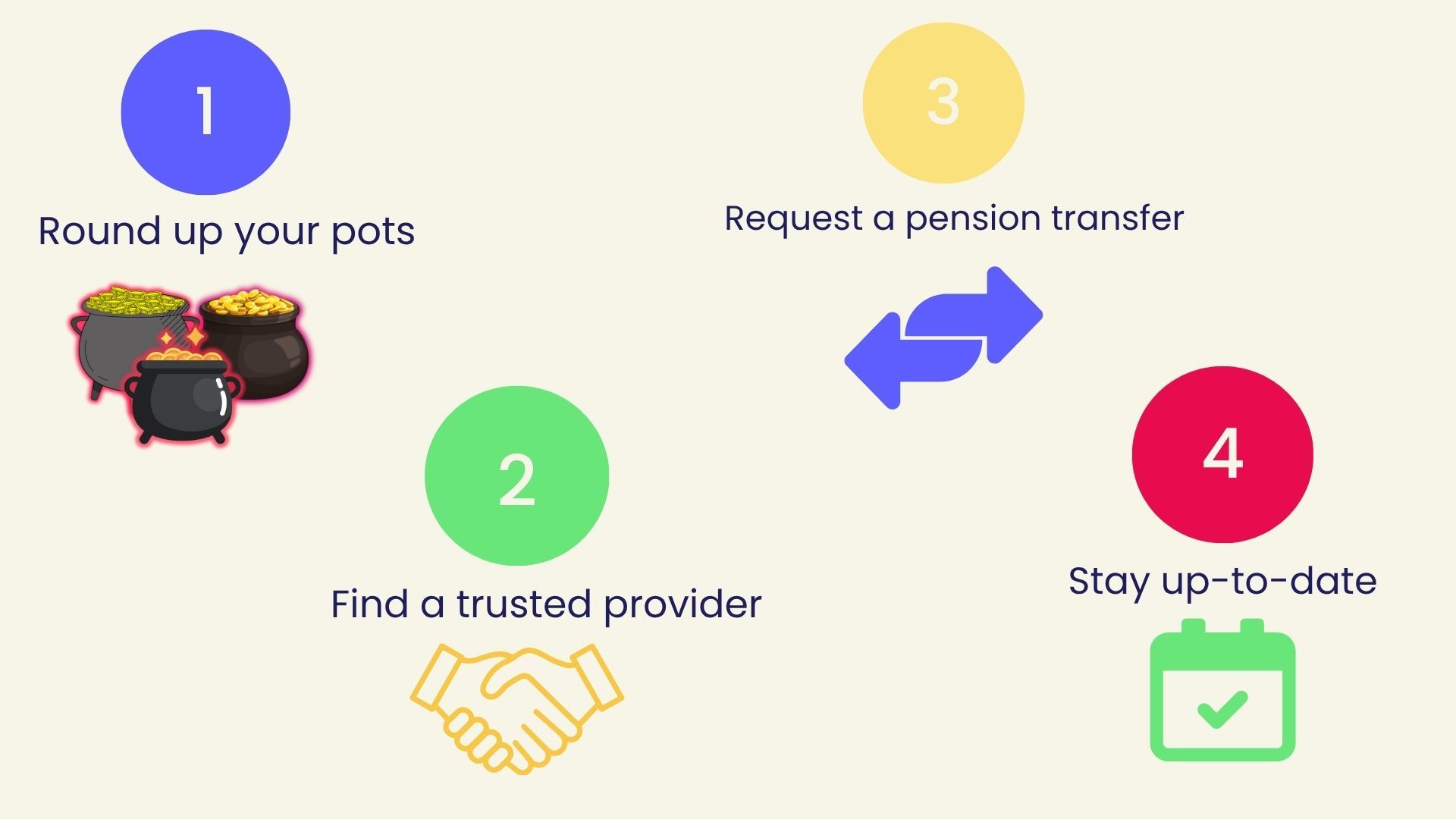
The first step in your pension consolidation journey is rounding up all your pots so you know exactly what you’ve got. If you’re trying to find details of an old employee workplace pension, the most straightforward way to find it is often to contact your former employer directly and ask. Alternatively, the government’s Pension Tracing Service can be used to track them down.
Find a lost pension
2. Find a provider you can trust
Next, you need to find a provider you trust to be a home for your retirement savings. This takes some shopping around and it’s important not to rush and pick the first deal you come across. Remember to pay close attention to charges – the fees you’ll be paying for your new provider and any exit fees you could incur from transferring from previous ones. PensionBee is a market-leading pension consolidation specialist, for example, but make sure you shop around and find the provider that you feel is right for you. Why not head to our pension compare tables to browse the market?
Compare pension providers
3. Request a pension transfer
Once you’ve settled on a provider, it’s time to start consolidating. Head to their website and apply to ‘transfer’, ‘combine’ or ‘consolidate’ your pension pots. You’ll usually be asked to fill out a form confirming your National Insurance and other personal details, as well as information about your pots, including their current provider, value and the policy number. This can all be found in your paperwork – either in your annual update or in the info pack you received when your pot was first set up. It may also have been emailed to you. If in doubt, reach out to your provider for confirmation.
Stay up to date
Congratulations – you've got the ball rolling! Now you’re waiting for the consolidation process to be completed. Many providers allow you to be notified of the progress of your application by email or SMS (text). You may need to select this as an additional option during the application process. Once the transfer is complete, you should receive confirmation in writing with a letter and often a welcome pack outlining the terms of your new pension policy. Remember to keep this safe so you can refer back to it at any time!
Pension consolidation FAQs
What’s the difference between ‘transferring’, ‘combining’ and ‘consolidating’ pensions?
Some providers might refer to ‘pension transfers’ while others may say ‘combining pensions’ or ‘pension consolidation’ - or they might use all of them interchangeably! Confusingly, you can see all three of these terms used to describe pension consolidation - but they all mean the same thing: the process of rounding up several pensions and putting them in one place.
How long does it take to consolidate pensions?
The amount of time it takes to consolidate your pensions depends on a number of factors, such as how many pots you’re combining. According to an April 2023 report by fintech firm Origo, the average pension consolidation takes around 14 working days. However, unlike switching bank accounts – where most providers give a 7-day guarantee – there is no guarantee when it comes to combining pensions and the time it takes can differ on a case-by-case basis. You can reach out to your provider to get a better idea of when you can expect the transfer to be completed.
Can you combine defined benefit pensions?
Yes - it is sometimes possible to combine some or all of your defined benefit (also called ‘final salary’) pensions into a single defined contribution pension (the most common type). However, not all providers allow you to do this, and remember that doing so would mean trading a guaranteed income for the rest of your life for a finite amount of money in a single pension pot. Most providers will recommend that you seek independent financial advice if you’re considering combining defined benefit pensions. You can use our adviser directory to find one who may be able to help you – just use the advanced filters to search for the ‘Pension transfers’ specialism.
Am I saving enough into my pension?
If you’re considering consolidating your pensions, you might be reviewing previous pots and wondering if you’ve been saving enough for your retirement. Boring Money’s research found 42% of non-retired people over 55 – so relatively close to retirement age – don't think they’re putting enough in their pension. This rises to 55% of those who are younger than 45. Fortunately, there are many ways you can boost your savings to ensure you have enough for the retirement you want. Check out our free course below for a helping hand.
How to save for the retirement you want