



Welcome to our course: Investing for beginners
New to investing? This free course takes 45 minutes and you don't need to sign up! Across seven short lessons and videos, you'll learn what shares and funds are, how ready-made portfolios do the hard work for you, why market ups and downs aren't the same as gambling, and why a Stocks & Shares ISA is usually the best place to start.
How does this investment course work?
⏲️ 45 minutes 📚 7 Lessons
In this course you will learn:
✔ How to understand investment risk
✔ Whether using funds is a good way to invest
✔ Ways to identify simple 'shortcut' routes to investing
✔ Which providers are good for beginners
Welcome to the first lesson in our series on investing for beginners! In this lesson, we explore shares in their most basic form - what are shares, how can I buy them, and what do they have to do with investing?
What is a share?
A share is a tiny slice of ownership in a company. Firms sell shares to raise money, and you can buy them through an investment platform, which trades on a stock exchange for you. Most beginners find it easier (and less risky) to buy lots of shares at once through a fund.
Many of us have spent the last few years watching obscure investment adverts, or struggling to decipher the investment products tied into our pensions, thus forgetting one of the core elements of investing
Investing, at its core, is about putting your money into a business you believe has potential to grow. This is where shares come into play.
What does owning a share in a company mean?
As Holly says in the above video, investing is just a large-scale version of Dragon's Den - only in this case, you're the Dragon. You have savings you’re looking to invest. Companies need money to grow.
Companies may choose to borrow this money from banks or investors, creating unnecessary debt. Alternatively, they can raise money from investors - like you - by selling a percentage (share) of their business.
So, you are the Dragon. The companies on the stock market are the ones doing the pitches. You are investing your money into a company that needs it, with the potential to profit as the business grows, or is sold.
How can I buy shares?
Rather than going to companies directly and asking to buy a share of their business, we access shares through a central market otherwise known as the Stock Exchange. Companies will 'list' on the Stock Exchange, which means anyone can buy or sell a share.
The Stock Exchange can be accessed through online investment platforms, many of which are beginner-friendly. These platforms allow you to purchase a small percentage of some of the world's largest companies - this ranges from BP to HSBC, Apple to Samsung, and Microsoft to British Airways.
You can either buy individual shares directly - through an online broker or an investment platform - or in a basket of investments that someone else picks for you, called a fund.
Why buy shares through a fund instead of on your own?
The concept of buying shares through a fund is similar to buying a mixed case of wine. You don't have time to pick individual bottles, or don't want the responsibility of choosing the best, so you let it be done for you. You're outsourcing the selection of individual components to someone else.
A single fund will usually house around 30-60 shares. Whilst someone else may have invested £1,000 into an individual share, a very small percentage of your £1,000 may be invested into the same company. If that business then takes a hit you won't be so badly affected - the majority of your money is invested elsewhere. Basically, you are spreading your bets for security.
When investing through a fund, you are unlikely to have to pay trading or transaction fees. You will, however, encounter management fees throughout the duration of your investment. If you want to buy a few shares or a fund then it's usually best to open up an account online, and use your annual tax-free ISA allowance if you can.
Should I buy individual shares directly?
When buying individual shares directly, you will encounter trading costs. For example, trading costs could be about £10 a pop and 0.5% stamp duty to the Government. This can accumulate to become an expensive way of buying small shares. The upside is that after initial purchase, you will not have to pay management fees as you would have with a fund - there's nothing to manage.
Buying a couple of individual shares is a risky way to get exposure to the markets - especially for less experienced investors. You have all of your investment tied into one or two businesses. If it goes badly for them, you're in trouble.
Shares are good for people who like to take an interest in the market, are time-rich and confident to make decisions themselves. Shares are not so good if you are busy, don’t feel expert in this subject, or will only pick shares in companies you know and love.
Will shares outperform cash over the long term?
The simple answer is yes, but you do need to be in it for the long term. Shares suffer from volatility in markets - you don’t want to be in a position where you need to withdraw your money when shares have taken a tumble.
A good stat to consider is this: Shares make more returns than having your money in cash, 9 times out of 10, in any 10-year period since records began! We think that is pretty good odds. You also need to think about whether you are investing for income or growth - if unsure, why not research shares further?
What's next?
In our next investing for beginners lesson, find out more about why a fund might, in fact, be a better option than buying individual shares. And below, find out from Financial Planner Carole Haswell which assets actually make up investments.
Thank you for completing Lesson 1!
Next up: What is a fund and why is it good for investors?
Welcome to the second lesson in our series on investing for beginners! In this lesson we delve a bit deeper into why funds might just be the best investment method for beginners.
What is a fund?
A fund pools money from lots of investors, and a professional manager spreads it across dozens or even hundreds of companies. To illustrate, a fund is a bit like an investment playlist - rather than choosing lots of individual songs (investments) yourself, you can pay someone else to assemble a collection for you. Your invested money will then be divided and shared between, well, shares!
A fund is a great option for beginner investors - much more secure than going all Wolf of Wall Street, shouting 'Buy!' and 'Sell!' for every business that looks like it could be 'the next Facebook'. Just picking up odd shares here and there is probably not the best way to go.
What does a fund manager do?
The best part about having a fund is having a fund manager. A fund manager will typically employ a vast array of clever people who are good at Maths to trawl through thousands of investments, pulling together a curated list which usually has between 40 and 100 investments in it. All the work is done for you!
They will then offer you - the investor - the ability to buy what is called a ‘unit’ of this fund.
Can I start investing in a fund with a small amount of money?
When investing through funds, the best thing to do is to start small and work your way up. Imagine, for example, a fund which invests in UK shares - you can typically invest amounts starting from only £10. This £10 is then spread across loads of companies, minimising the risk of any one dodgy investment. And if it does go south, you’ve still only invested £10.
There are literally hundreds and thousands of funds out there, from regions to countries, investment types and themes. Gold, US Shares, Property, Technology, Healthcare, Emerging Markets - the list is never-ending! Baby steps are the way forward when you’re starting to invest.
What is diversification and why does it matter?
When it comes to investment funds, diversification is the name of the game. Investors can benefit more from having a broad mix of asset classes - this could include shares, bonds, property, gold, cash, and more. There is also the theory that different parts of the world see success at different times, so having investments in a range of regions could potentially be valuable too.
An example that demonstrates this well saw the UK's Financial Times Stock Exchange (Also called “Footsie”, the name for the share index made up of the largest 100 companies by market capitalisation (total value of all shares) listed on the London Stock Exchange. Index) in a sad position compared to the US Standards and Poor's (An index that tracks the performance of the 500 largest publicly traded companies in the United States. It's often used as a benchmark for the overall global stock market. Index), which soared alongside technology firms such as Apple, Google (Alphabet), and Tesla. That is, before Mark Zuckerberg went all weird and 'Meta', and the other companies got over-valued.
How many funds do you need?
There isn't really a standardised set amount of funds an investor should have. In general, the rule of thumb is that investors should have between 5 and 20 funds, depending on the amount they wish to invest. It's always best - no matter how many funds you invest in - to spread your investment across different regions, sectors, and asset classes.
What are the three ways to start investing as a beginner?
Now that you have a grasp on investment shares and funds, it’s time for the next step. To quote Elvis, a little less conversation and a little more action - time to take your first investment baby steps.
- Go it alone. There are plenty of resources out there, making it plausible to do a bit of research on some of the best funds to invest in, and just go it alone. Naturally, this can feel daunting - this is where we come in. Our Best for Beginners shortlist is a great place to start, with tried and tested options waiting for you.
- Get some help. Through companies such as Bestinvest, you can get assistance finding low-cost advice options to help start your own portfolio, with someone at your side backing your decisions. Dodl is another low-cost investment app created by AJ Bell in 2021 - designed to help beginner investors with simpler portfolios.
- Find a multi-asset fund or ready-made portfolio. As explained in detail in Lessons 3 and 4 of this course, multi-asset funds and ready-made portfolios are premade, diversified investments. They're a great option for those who aren't sure where to start or just feel more comfortable leaving the number-crunching to the experts.
What’s next?
In our next investing for beginners lesson, meet the multi-asset fund - the one-stop shop to access lots of different shares and investments, in just one place!
Thank you for completing Lesson 2!
Next up: What is a multi-asset fund?
Welcome to the third lesson in our series on investing for beginners! In this lesson we will be taking a look at multi-asset funds, the risk they may (or may not) pose, and much more!
Multi-assets funds are a great way to have a diversified portfolio and can be likened to an investment ready-meal. Instead of buying all the ingredients yourself and worrying about putting it together, you can outsource everything to an investment manager and have them do it for you.
How does a multi-asset fund work?
When putting together a multi-asset fund, the investment manager will consider the full range of all investment types and blend together the right mix for you. They will look into shares, bonds, property, commodities, gold, cash, and more in order to find the best blend. These are known as asset classes.
There is a well-established school of thought known as the Modern Portfolio Theory, which suggests that the right blend of these asset classes will produce a certain return for a certain amount of risk. The more risk you take, the higher the returns will be.
Most portfolios do incorporate a diversified range of assets, so you're never putting all of your eggs in one basket. Although this sounds like a positive, it still puts people off - they still don't know what to pick. A multi-asset fund takes the decision out of your hands, and instead outsources this.
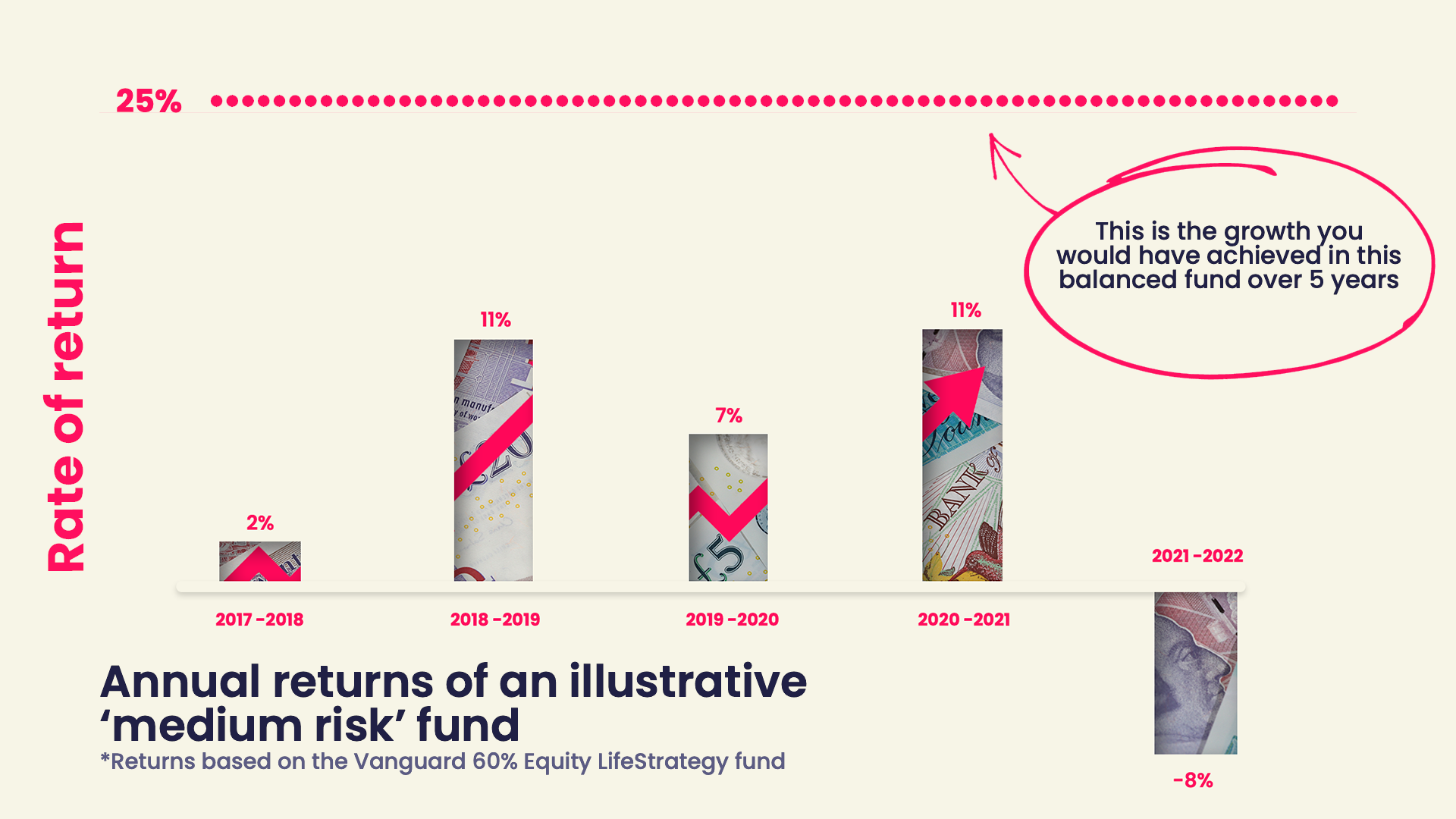
The precise mix of asset classes is important because different combinations take investors on different journeys. The higher the ratio of low-risk assets - such as cash and bonds - the smoother the ride should be, although potential returns may be lower.
How do I choose a multi-asset fund?
When you are investing in a high-risk multi-asset fund - this could include a high proportion of shares, or 'equity' - your journey is likely to be bumpy, but your returns may be great in the long term. This can be a great option for those saving for a pension. If you are looking for a shorter investment term - say 4 or 5 years - you may benefit from looking at multi-asset funds with a lower risk profile.
Most managers will offer you multi-asset fund options, but in general they tend to fall under these three categories:
- Defensive or Cautious: A low-risk multi-asset fund, usually limited to between 4% and 20% in shares.
- Balanced: A medium-risk choice, often containing around 60% in shares.
- Adventurous or Aggressive: The highest-risk multi-asset fund, which could contain 80%-100% in shares.
Once you have decided your blend of asset classes, and the risk you are willing to take, the fund manager will decide how to populate your multi-asset fund.
Multi-asset funds are much like Russian dolls. Inside the shares doll, the manager will then choose to include individual companies - Barclays, Heineken, Microsoft, Shell, and Tesla, for example. Inside the bonds doll, they might include both UK Government bonds and German Government bonds, and this continues for each asset class.
How much risk should you take?
This is the one choice you must make before you get to buy a unit in a multi-asset fund, giving you exposure to thousands of investments in a range of asset classes. It's as simple as that.
You can find multi-asset funds with some of the world's largest fund managers, such as BlackRock, Legal & General, and Vanguard. Online investment platforms can be a great way to find these, and to make it even easier for you we have collated a list of some of our favourite investment platforms for beginners. Just open an account and pop in a multi-asset fund.
What's next?
In our next investing for beginners lesson, meet the ready-made portfolio - where you can get the experts to put together the perfect premade investment portfolio, and you don't even have to lift a finger.
Thank you for completing Lesson 3!
Next up: What is a ready-made portfolio?
Welcome to the fourth lesson in our series on investing for beginners! In this lesson we introduce you to the ready-made portfolio. What is it? How do they work? Could they be the investment option for you?
What are ready-made portfolios?
The term "ready-made portfolio" may sound a bit off-putting and technical, but really they are a fantastic option for beginner investors. They're a type of multi-asset fund but are designed to help you invest with minimum fuss - and minimal experience required - so you can’t really go wrong.
The teams that run ready-made portfolios put these premade investment packages together using a range of underlying investments, all designed to behave a bit differently. Some investments will be less volatile for a smoother ride - like cash - but lack the potential to make much profit in the long run. Others will fluctuate more - like shares - but will be expected to make you more money over time.
You may have seen the term ‘risk profile’ floating about - this is mentioned a lot in the world of ready-made portfolios and understanding it is crucial to make sure you pick the right one for you. Otherwise you could end up with investments that don't reflect your needs and financial goals.
What is a risk profile?
'Risk profiles' - essentially, how much price volatility you can expect from your investments (more on this in Lesson 5) - usually sit within either the low, medium to high range. These are typically paraphrased with words like 'Defensive' or 'Cautious' (low), 'Balanced' (medium), and 'Adventurous' or 'Aggressive' for portfolios at the higher end of the risk profile spectrum.
Ready-made portfolio providers typically guide you to the best option for you, using an online or app-based questionnaire. In this, you'll typically be asked a range of 5-15 fairly simple questions, and your answers help them to suggest the right ready-made portfolio for both your needs and your preferences.
The questionnaire will usually suggest which ready-made portfolio and risk profile is best suited to you. If you're comfortable with their proposition, then you accept the suggestion and they make it happen for you. Simple as that!
The end result for you is a varied investment portfolio that you don't have to manage. A good blend of regions, sectors, and thousands of individual investments will be picked, managed, and tweaked for you on an ongoing basis. Think of it like an investment ready-meal - rather than needing to pick out and blend all of the ingredients yourself, it's already been done for you.
You can read more about ready-made portfolios and how they work in further depth in our full guide by clicking the link below.
Find out more about ready-made portfolios
What is ESG investing?
In recent years, many ready-made portfolio providers have started to offer sustainable versions - often known as 'Ethical', 'Socially Responsible' or simply 'Sustainable'. This may not be consistent across brands and companies, so it's best to do your research if sustainability is important to you.
Investing is complicated, and you may find that hidden within your portfolio are - for example - oil stocks. This will be disappointing for some eco-warriors, although some investors see a way around this. They argue that by holding the shares, they can hold these companies accountable and force them to set up and communicate transition programmes of change to cleaner energy.
The point is that you need to dig under the bonnet to check that the portfolios you invest in are prioritising the things you care about.
Get the low-down on sustainable investing
Can I hold a ready-made portfolio in an ISA or pension?
Most ready-made portfolio providers now offer ISAs and personal pensions - sometimes known as Self-Invested Personal Pensions (SIPPs). Some even offer Junior ISAs for the kids, and others will offer Lifetime ISAs for those under 40 saving for a first property. Lifetime ISAs may receive Government top-ups, but could have penalties attached to withdrawals. Always research before you apply.
As always, the trade-off between Stocks & Shares ISAs and pensions is that ISAs are flexible - you can take the money out whenever you want - but pensions give you Government top-ups, really boosting your savings. The downfall to pensions is that you can't access the money until you’re in your late 50s.
There is nothing stopping you from having both open, and building them up slowly, though ISAs are generally the best starting account for beginners. Tax-free, easy to access and simple.
Which ready-made portfolios are performing best right now?
As there are so many ready-made portfolios on the market, and because they all contain different investments split in different ways, it can be hard to compare and determine if the one you’re investing in is actually performing well – or if, maybe, it’s not living up to your expectations. That’s where we come in.
Every quarter (three months), we crunch the numbers for you and analyse the ready-made investment market to identify the top performers, so you can see how well your investment is faring compared to similar portfolios. Click the link below to see the latest figures.
Top performing ready-made investment portfolios
What's next?
In our next lesson, discover what on earth we mean by the word 'risk' - and why it isn't as scary as it sounds.
Thank you for completing Lesson 4!
Next up: Is investing risky?
Welcome to the fifth lesson in our series on investing for beginners! In this lesson we will be talking about all things risk. What is it? How do we tackle it? And why is it an important part of investing?
What is investment risk?
You may have heard us touch on risk in previous lessons, but did you know it's the number one thing that puts people off of investing? We've all read the headlines - markets are falling, crypto is crashing, and who wants to gamble with their hard-earned money?
The simple answer is, nobody. But there is more to consider. Investment risk is not the same as say gambling, skiing down the black run, or even driving on the motorway at 100 miles per hour. It is all about volatility, and how much markets can fluctuate in any one year - if you're saving for 30 years, the ups and downs of today really don't matter so much. Timeframes play a huge role in investment risk.
How long should I invest for?
Investment markets are unpredictable. If we use 2008 as an example - for every £100 you invested in the FTSE 100, you would have lost around £30. This sounds pretty catastrophic, right? Well, continue into 2009 and you would have made about £28 of this back. Following this, we entered a decade of growth buoyed by low interest rates, sexy tech companies, and lots of cheap money sloshing around - you will have more than likely made your money back, and then some!
The point here is that, if you had only invested for a short time, you could be £30 down on every £100 you invested. By continuing your investment long-term, you are giving the market a chance to thrive, with great returns in the long run.
As well as volatility, there is also the risk of things going wrong. You can mitigate this risk by not investing in new, quirky things which are still unproven to be valuable - crypto, for example.
How do investors feel about risk?
Research from Boring Money’s 2026 Online Investing Report found that the main motivation cited to invest is to get ‘better returns’ – with 32% of people stating that this was the reason that prompted them to start investing in the first place.
But even amongst those who do invest, many are still uncomfortable around the idea of taking risk with money – just 29% of investors agree with the statement: ‘I am comfortable taking on a lot of risk when it comes to my investments’, however, only 8% of low confidence investors agree.
Risk aversion in general accelerates with age, with only 14% of those aged over 65 willing to invest in the next 12 months, compared to 50% of 18-34 year olds.
Could I lose all my money by investing?
When we ask a group of beginner investors how much they think they might lose, it’s not uncommon for a few people to say ‘everything’. This is highly unlikely, as long as you invest smartly.
Take the 100 biggest companies listed on the Stock Exchange today. That bunch includes HSBC, British Airways, BP, and ITV. What is the chance they will all go bust at the same time? Next to none!
So it’s really, really, really unlikely that investments in big brands and mainstream categories will go pop. They may still have rough periods - such as when Covid first hit, or when Liz Truss unleashed THAT mini-budget. For the most part, they will recover.
Risk is something truly important that we should all consider when investing. It is also important to remember the very real risk of locking yourself into inevitable losses when you leave your money in a current account. Inflation will chew away at this, so we also need to consider the risk of not making our long-term savings work hard enough.
Fundamental to investing is that with a greater acceptance of risk, there is a great opportunity for reward. However, most people don’t see risk in those terms. Most people see risk as something to be avoided.
Why shouldn’t I trust my gut when investing?
To really learn more about how your brain thinks about risk, watch this video with behavioural psychologist Paul Davies. Here he explains how we need to be tough with our inner chimp, and spot when our instincts might be leading to poor decisions. This 10-minute watch is genuinely brilliant, interesting and will change how you think about risk. This could make you a much better investor than reading any dry economic textbook!
- Why risk = loss in our minds
- How the finance industry can communicate risk better
- Why brain function is to blame for our bad relationship with risk
- What happens at the cliff edge of decision making
- Why passive decisions on money are actually easier to make
- How you can calm your inner chimp and help the rational brain guide decision-making
What’s next?
In our next investing for beginners lesson, find out why ISAs should be a no-brainer for most—with a handy audio to tell you all you need to know.
Thank you for completing Lesson 5!
Next up: Why should beginners use a Stocks & Shares ISA?
Welcome to the sixth lesson in our series on investing for beginners! This session is all about ISAs, and why it's a no-brainer to set one up today.
What is an ISA?
ISA stands for Individual Savings Account, and essentially that explains it. The key element that differentiates ISAs from regular savings accounts is that you get to accrue interest tax-free.
You can invest as little as £1 depending on your bank, all the way up to £20,000 into a cash and/or stocks and shares ISA each year.
NB: From April 2027, the Cash ISA limit for people under 65 will drop to £12,000. However, the overall ISA limit will remain at £20,000, which means the remaining £8,000 must go into a Stocks & Shares ISA.
Is a pension better than an ISA?
If you're a beginner looking for easy access to your money - and have no material investments elsewhere - an ISA should be the no-brainer choice for you. You should, however, consider the benefits of having a pension as well.
Sure, with a pension your money is locked away until you're 55+, BUT you do receive substantial free top-ups from the government. For example, a basic rate taxpayer will receive 20p from the Government, paid into their pension, for every 80p they pay in themselves.
There will be Terms and Conditions that apply, as with any financial contract. Always do your research before applying. That being said, pensions are a compelling savings option for those with longer time frames - especially higher or additional rate payers who get an even more generous tax relief.
What’s next?
In our final investing for beginners lesson, take a look back at what we have covered in this short course, and revisit the top 10 things you need to know as a beginner investor.
Thank you for completing Lesson 6!
Next up: What are the 10 things to know before you start investing?
Welcome to the 7th and final lesson in our series on investing for beginners! Here we will recap with a 10-point summary of what we think you should be aware of as a beginner investor.
1. What are the 5 main types of investment?
There are 5 main types of investment that retail investors tend to think about:
To recap the less obvious assets: bonds are when we lend money to countries and companies in return for some interest along the way. The riskier the country or the company, the higher the interest rate on offer. Shares - or equities - are literally buying ownership of a small fraction of the company.
2. Why should I mix different types of investment?
Generally, it’s a good idea to have a mix of the assets listed above. They balance each other out.
If, for example, a natural disaster were to occur, shares would typically fall because it is seen as a threat to the normal functioning of companies and markets. No-one's thinking about buying a new car, flying, or importing steel for their factory when countries are in crisis.
On the other hand, the price of gold would probably soar. It’s tangible, low risk, you can keep it under the bed - it’s seen as safe when everything else is not.
3. What’s the difference between investment risk and volatility?
We all know that investing carries risk, but not the same kind as running across a motorway! Investment risk typically means volatility, and is not to be confused with being cavalier - or putting it all on black. It’s just describing how much something fluctuates in value. Cash is like a staid old tortoise. Bonds are like a gentle wave. UK shares are like the Peak District. And Emerging Market shares are like a grasshopper on speed.
4. Why does time in the market matter?
An important aspect of investing is how long your timeframe for investing is. You want to avoid being a forced seller when things aren't looking too good. If you had invested in 2005 and needed the cash to buy a house in 2008 - after the global meltdown - you would have been out of luck. If, however, you had invested in 2005 and taken the money out in 2015, you would have made 74%.
The longer your timeframes, the more volatility you can stomach. If you are saving for 20 years and are sitting in the comfort blanket of cash, the major risk is that you won’t have enough money when you retire.
5. Should beginners buy funds instead of individual shares?
Less confident or time-poor investors should avoid buying single shares - or following tips from so-called ‘experts’. Use a fund. This has been true since the 1600s, when investors realised that packaging together and backing multiple ships and journeys of the East India Company was smarter than backing one which could easily be sunk or raided.
Think of a fund manager like a personal shopper - you employ them to find the best combination of things for you, and match them together. A fund will typically have about 30–80 investments in it, so you don’t have to do the choosing or monitoring.
6. Why are multi-asset funds a good first investment?
A great way to start investing is through a multi-asset fund. Think back to 'diversity of funds', and take away all of the hard work. All you have to do is pick one investment fund, and the experts will blend together asset classes from different regions - a dash of China, a dollop of bonds, and a pinch of Apple.
A passive multi-asset fund is the cheapest way to get started. Or opt for a ready-made portfolio that matches how much risk you're comfortable with. Generally, this means taking into account your timeframe. 5 years or less? Go less risky. 10 years or more? Spice things up a bit.
7. How much can I invest tax-free in an ISA?
Don’t pay more tax than you need to. We all have a £20,000 ISA allowance every year. An ISA is like a see-through financial Tupperware box you stick your investments into, and the tax man can’t get into it. Use it.
8. When is the best time to start investing?
There is no right time to start investing, and no-one has a clue what the future holds.
We live with dodgy global leaders, oil price shenanigans, pandemics and in a nation that likes Love Island. This all defies logic - and how grown-ups should behave. Drip feeding in a little every month on a direct debit is a good way to smooth out the price at which you buy into the markets.
9. What should I do when the stock market falls?
Do not panic if things go south during your first year of investing. In 2008, £1,000 in the A global index tracking approximately 4,000 medium and large-sized companies around the world.fell to about £700. The next year, it almost made it all back.
10. What’s the most important investing habit?
Save, save, and save. Ignore all the waffle, jargon, and over-complexity. If the experts could really predict what markets would do, they wouldn’t need to work as experts. Save as much as you can, as often as you can, as early as you can. Pick a simple investment to get started with. Don’t overpay.
What's next?
You’ve come to the end of our investing for beginners course, and are ready to take the first step in your investment journey! Why not take a look at our Best Buy 2026 award winners to see which providers we think are a good place to start?
2026 Boring Money Best Buy award winners