





Everything you need to know about Investment Trusts
This type of fund allows you to pool your money with other investors to access a portfolio managed by an expert. We debunk how they work, which investing strategy they're good for, and what's trending in the world of trusts.


Compare the Boring Money Rated Investment Trusts
Already comfortable with trusts? We screen the whole market on size, pricing, discount to NAV, gearing and sector over five years, then assess how clearly each one communicates. Compare the trusts that cleared every filter, and see the numbers behind the Rated badge.
Investment Trust related articles
Dive deeper into our handy articles - on everything from the best-selling Investment Trusts of the month to the latest trends in the sector!









Investment Trust webinars
Recap on one of our exclusive live webinars about Investment Trusts, with our Founder & CEO Holly Mackay and expert guests!
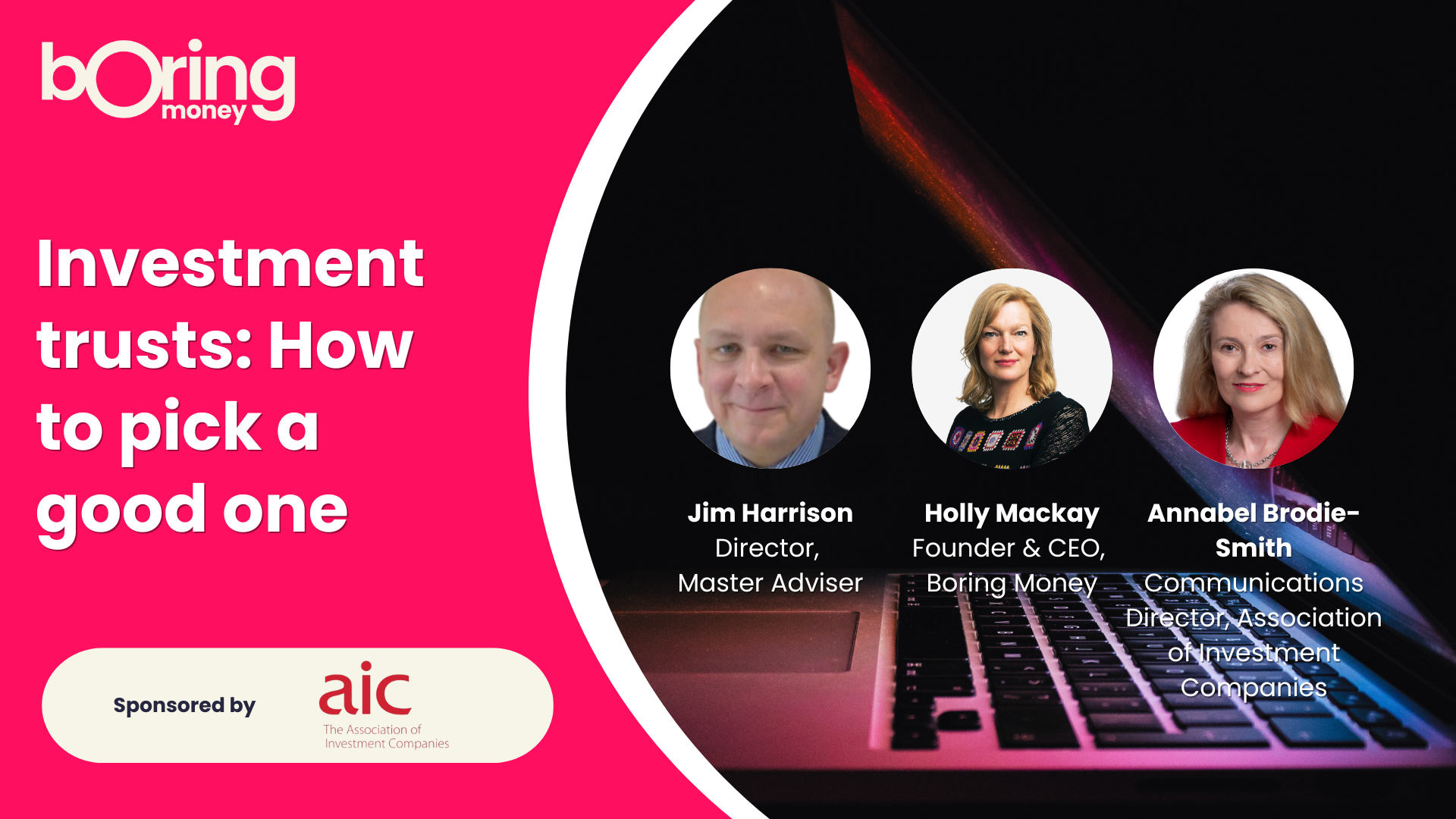
Investment Trusts: How to pick a good one
Rewatch Boring Money's Founder & CEO Holly Mackay discuss how to invest with investment trusts with Annabel Brodie-Smith, Communications Director at The Association of Investment Companies, and Jim Harrison, Director of Chancery Lane Income Planners.

Talking technology with Polar Capital's Ben Rogoff
Rewatch Boring Money's Founder & CEO Holly Mackay chatting about all things investment trusts and technology with Chartered Financial Planner Dennis Hall and Polar Capital Fund Manager, Ben Rogoff.
Frequently asked questions about Investment Trusts
What is an Investment Trust?
An Investment Trust is a company listed on the stock exchange that pools investors' money into a portfolio run by a professional fund manager. You invest by buying its shares. Trusts are closed-ended, meaning they have a fixed number of shares, and an independent board oversees the manager on behalf of shareholders.
What's the difference between an Investment Trust and a fund?
Open-ended funds (OEICs and unit trusts) create or cancel units as investors buy and sell, and are priced once a day at the value of their holdings. Investment Trusts have a fixed number of shares traded on the stock market, so supply and demand set the price. Trusts can also borrow to invest and save income for leaner years.
What does it mean when an Investment Trust trades at a discount or premium?
A Trust's share price can differ from its net asset value (NAV), the value of its investments per share. If the share price is below NAV, the trust trades at a discount; above NAV, at a premium. A 10% discount means buying £1 of assets for 90p, though discounts can widen further after you buy.
What is gearing in an Investment Trust?
Gearing means an Investment Trust borrows money to invest, aiming to boost returns. A Trust that is 10% geared has borrowed an amount equal to 10% of its net assets. When markets rise, gearing magnifies gains; when they fall, it magnifies losses. Open-ended funds generally can't borrow this way, so gearing adds extra risk.
Are Investment Trusts good for income?
Gearing means an Investment Trust borrows money to invest, aiming to boost returns. A Trust that is 10% geared has borrowed an amount equal to 10% of its net assets. When markets rise, gearing magnifies gains; when they fall, it magnifies losses. Open-ended funds generally can't borrow this way, so gearing adds extra risk.
Are Investment Trusts good for income?
They can be. Unlike open-ended funds, Investment Trusts can keep back up to 15% of their income each year in a revenue reserve, then use it to top up dividends in tougher years. This helps some Trusts deliver a steadier, rising income over time, though A payment made by a company to its shareholders, typically representing a distribution of the company's profits. are never guaranteed and can be cut.
What are the AIC dividend heroes?
Dividend heroes are Investment Trusts that have increased their dividend every year for at least 20 consecutive years, as tracked by the Association of Investment Companies (AIC). Examples include: City of London Investment Trust, Bankers Investment Trust, Alliance Witan, Caledonia Investments and The Global Smaller Companies Trust. A strong record doesn't guarantee future payouts.
What are the pros and cons of Investment Trusts?
Pros:
Expert-managed
Diversified portfolios
Ability to smooth dividends using revenue reserves
Fixed pool of money suited to less liquid assets like property or infrastructure
Cons:
Share prices can swing more than the underlying assets
Discounts can widen
Gearing magnifies losses as well as gains
How do I buy Investment Trusts in the UK?
You buy Investment Trust shares on the stock market, usually through an online investment platform or stockbroker and can hold them in a Stocks & Shares ISA or SIPP for tax benefits. Expect a dealing fee each time you trade, 0.5% stamp duty on most purchases, the Trust's The total cost of holding an investment over the course of one year. It typically includes the management fee and other charges. and any platform fee.
How do I choose a good Investment Trust?
Start with the Trust's strategy and whether it suits your goals and timeframe. Then check its long-term performance against its sector, ongoing charges, level of gearing and whether it trades at a discount or premium to NAV. Boring Money's Rated Investment Trusts screen the market on these factors to help narrow your shortlist.