




State Pension 2027: how much will it likely rise under the triple lock?
Written by Boring Money
15 Sep, 2026
The triple lock looks set to deliver another above-inflation rise next April, worth almost £490 a year to those on the full new State Pension. We break down how the triple lock actually works, why wage growth is likely to be the number that counts this year, what the rise means in pounds and pence for both the new and basic State Pension, and a tax quirk that could catch some pensioners out.

What is the triple lock and how does it work?
The State Pension is set to rise again next April, thanks to the "triple lock" - the rule that determines how much it goes up by each year. Under the triple lock, the State Pension increases in line with whichever is highest out of three figures:
- Average wage growth
- The cost of living (Term used to describe how quickly the prices of goods and services is rising over a period of time. In periods of high inflation, prices are increasing rapidly, whereas low inflation means prices are increasing by only a small amount.)
- 2.5% - the guaranteed minimum rise, whatever happens to wages or prices.
The rule exists to make sure the State Pension keeps pace with the cost of living, wherever the economy is heading.
Why is the State Pension likely to rise?
This year, wage growth looks set to be the winner, after new data from the Office for National Statistics showed average earnings, including bonuses, grew by 3.9% between May and July. [1]
That 3.9% figure now goes head-to-head with September's inflation figure, which won't be published until October, and the fallback rate of 2.5%. With inflation currently running at 2.9%, it looks increasingly likely that wage growth will end up being the number used to calculate next year's rise, unless inflation jumps sharply in the coming weeks. The final figure will be confirmed once the Government has all three numbers to compare.
This means that pensioners could be almost £490 better off over the course of the year as a result.
it’s extremely likely that today’s 3.9% increase in average earnings will be the figure used in the calculations for 2027.

How much will the new and basic State Pension be from April 2027?
This year, the full new State Pension pays £241.30 a week, which works out at £12,547.60 a year. If the 3.9% wage figure is confirmed in October, then from April next year it would rise to £250.70 a week, or £13,036.40 a year.
Those on the older basic State Pension currently receive £184.90 a week (£9,614.80 a year), rising to £192.10 a week (£9,989.20 a year).
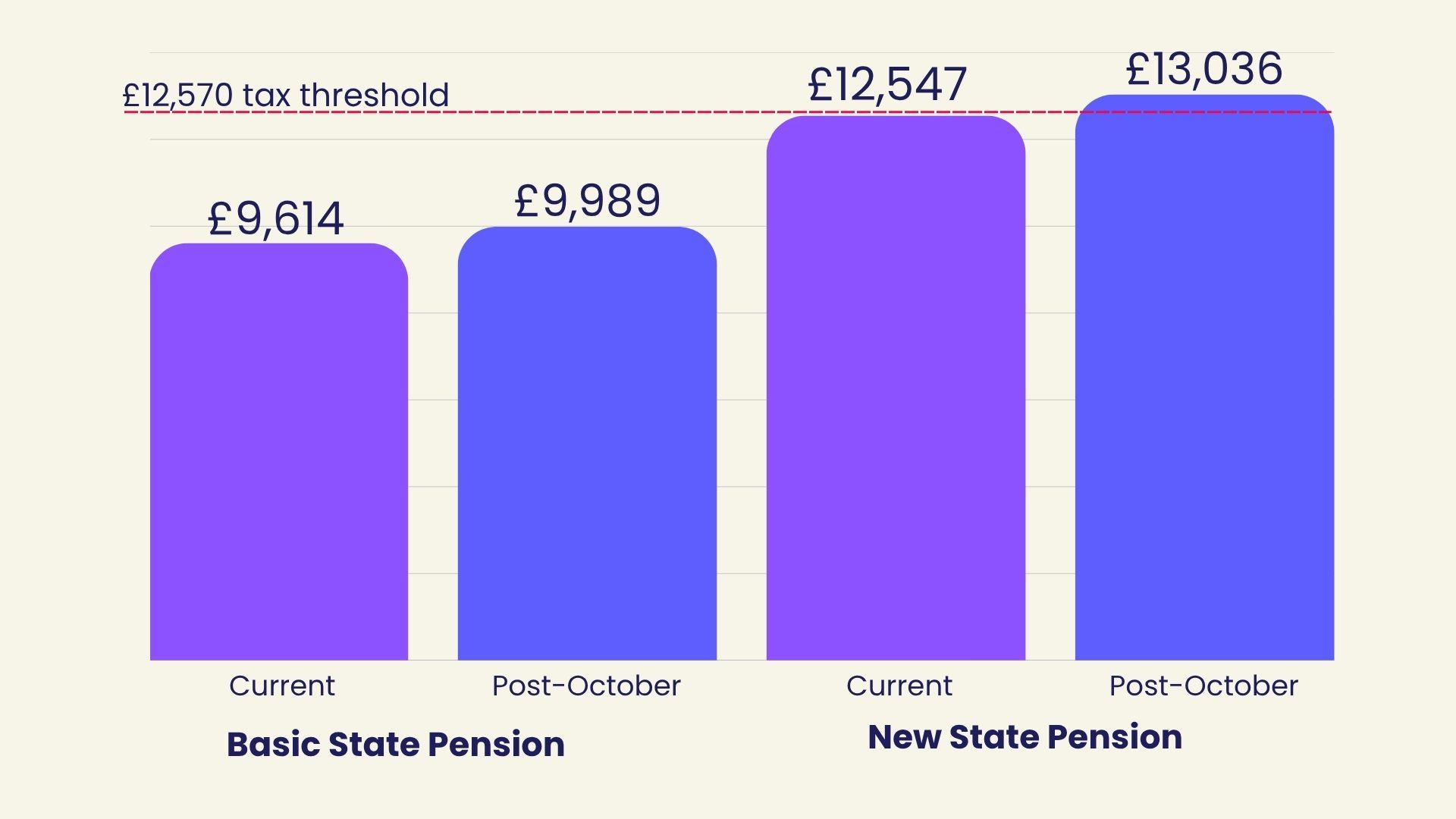
Disclaimer: These figures are unconfirmed and are subject to change.
Will pensioners have to pay tax on the State Pension?
The minimum income tax threshold is frozen at £12,570 a year. This means pensioners whose only source of income is the State Pension will now need to pay income tax. The Government has said it intends to introduce a waiver so pensioners whose only income is the basic or new State Pension won't have to pay income tax on it at all, though it hasn't yet published exactly how that mechanism will work. Watch this space!
—-
[1] ONS






Post a comment:
This is an open discussion and does not represent the views of Boring Money. We want our communities to be welcoming and helpful. Spam, personal attacks and offensive language will not be tolerated. Posts may be deleted and repeat offenders blocked at our discretion.
Your opinion matters
Be the first to comment.