



Maximising Your 25% Tax-Free Lump Sum: Options, Considerations, and Expert Advice
By Boring Money
22 April, 2025
You’ve finally shaken off the corporate shackles and it's time to use those carefully nurtured pension savings to support you for the rest of your life. No pressure! One of the perks of retirement is that you can take 25% of your pension fund tax-free. However, there are some important considerations before you start drawing down from your pot.

What is the 25% tax-free lump sum?
The main aim of a pension is to create an income stream when you are no longer earning a salary, but the government also allows you to take 25% of your pension pot as a tax-free lump sum, up to a maximum of £268,275.[1]
At the moment, you can do this from the age of 55 onwards, though this is rising to 57 from April 2028. There are circumstances whereby individuals can withdraw even more, but the rules are complex and typically require professional financial advice.
Lump sum withdrawal options
Take it all at once
You can take the whole 25% lump sum in one go and leave the rest invested until you need an income. This can be a useful approach if you are planning a phased retirement and need some cash for a few years to tide you over, or if you are planning some major expenditure.
Take less than the full allowance
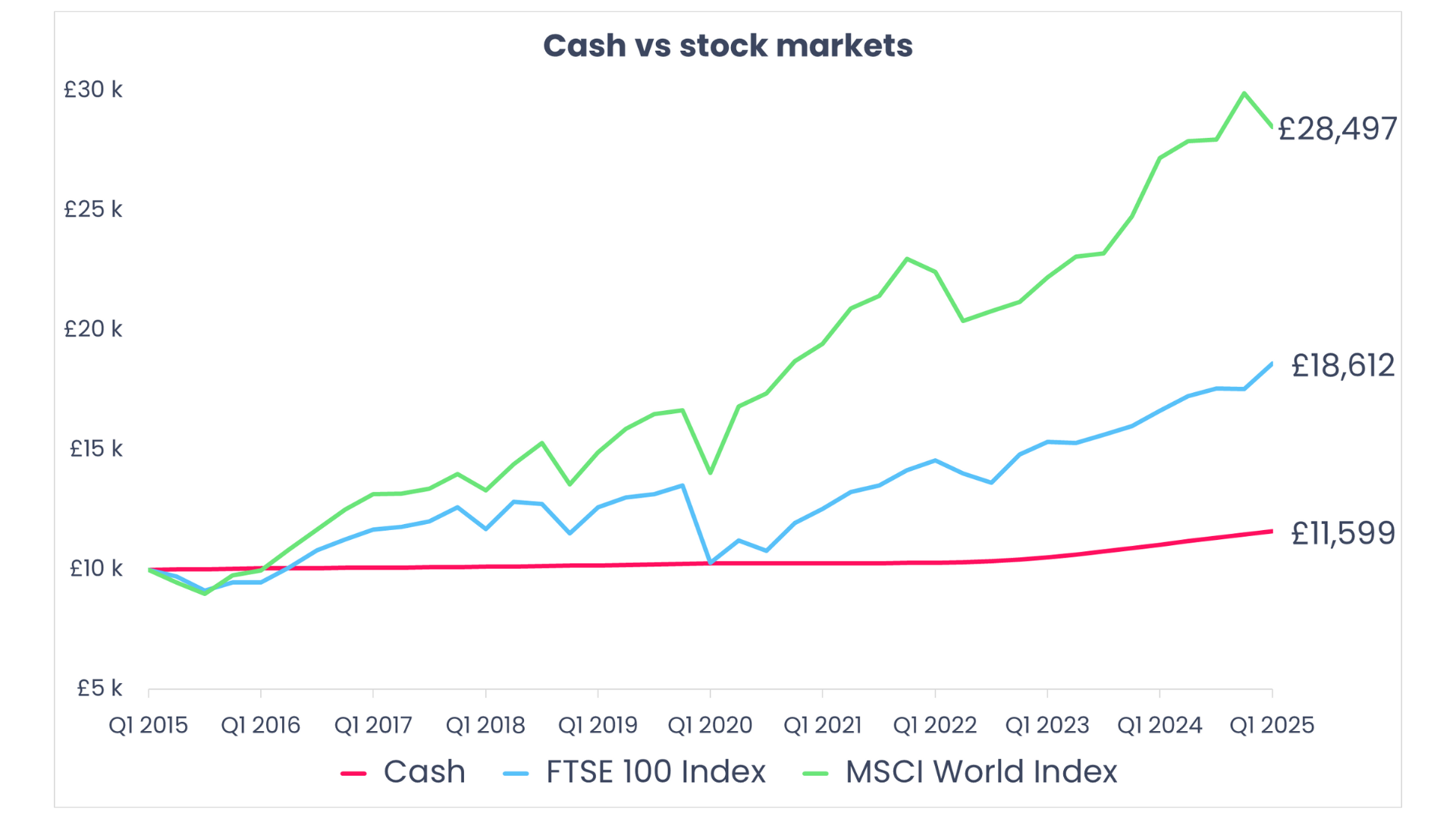
You don’t have to take it all in one go. Remember that any money that stays in your pension fund will remain invested and continue to grow, so it can be worth leaving it in place if you don’t need it immediately. You may end up with a larger amount later on because stock markets tend to grow faster than cash over time.
Cash vs stock market returns, 2015-2025
Take more than the full allowance
You can take out more than 25%, but you will need to pay tax on it at your marginal rate (i.e. at the same rates you would if it was your salary). If you don’t have a lot of other income, this can be worth doing, but you need to factor it into your calculations.
If you're a higher rate taxpayer this year, for example, and you might fall to being a basic rate taxpayer in the future, you need to time when you take any income with care to prevent yourself bumping back up into the higher tax bracket.
Income Tax bands explained
Income Tax Band | Taxable Income | Income Tax Rate |
Personal Allowance | Up to £12,570 | 0% |
Basic Rate | £12,571 to £50,270 | 20% |
Higher Rate | £50,271 to £125,140 | 40% |
Additional Rate | Over £125,140 | 45% |
Income Tax Band | Taxable Income | Income Tax Rate |
Personal Allowance | Up to £12,570 | 0% |
Basic Rate | £12,571 to £50,270 | 20% |
Higher Rate | £50,271 to £125,140 | 40% |
Additional Rate | Over £125,140 | 45% |
Correct as at 2025-26 tax year.
Three things to consider before taking your lump sum
Your long-term income needs
A large sum payout has obvious appeal. It is tempting to look at that fast car, once-in-a-lifetime trip or new kitchen and splash out. However, it is important that taking the lump sum shouldn’t compromise your ability to create an income with the remainder of your portfolio. You need a clear idea of the income you need to live the retirement you want, with a bit left over for emergencies.
Your future contributions
Once you have taken your lump sum, you have "activated" your pension fund. That means you are limited in how much you can contribute tax-efficiently into your pension from then onwards. You can only put in £10,000 a year once you have started to draw from your fund (this is known as the Money Purchase Annual Allowance [MPAA]).[2] This may not be an issue if you have already saved a large pot, but it might be a consideration if you want a phased retirement, and plan to retain some paid work.
What you plan to do with the cash
There can be a timing problem with taking your tax-free lump sum. In a worse case scenario, you take money out of a pension fund at a low point in the stock market cycle and then put it into a low-paying cash account and it has no time to recover. In reality, most pension funds will help you manage this transition by moving into lower risk assets ahead of any withdrawal, but it’s not always the case. If you don’t need the money immediately, consider how you might invest it to ensure it doesn’t get eaten up by inflation, or miss a bounce in markets.
Learn how to invest in retirement
Changes to lump sum rules
There are always concerns that a cash-strapped Chancellor will tinker with the tax benefits on pensions, including adjusting the amount that retirees can take as a lump sum. If there is a change, the biggest problems may arise for public servants with large final salary pension schemes, such as doctors and senior civil servants.
However, retirees need to be wary about acting ahead of rumours, which tend to crop up before every budget. There will be consequences to making additional withdrawals, so be careful that it doesn’t dent your long-term plans. It is likely that there will be interim arrangements in place if any changes are made.
Also, be aware that there are restrictions around pulling money out of a pension and then putting it back in later - this is known as "pension recycling". Some people think that by putting the withdrawn money back into your pension, you can generate additional tax relief, and possibly build up fresh entitlement to more tax-free cash. However, there are rules to stop this happening.
There are limits; This pension money will typically be money which you won’t have paid any tax on because you will have received tax relief when contributions were originally made and paid no tax on the withdrawal. It’s a bad idea to get on the wrong side of the recycling rules, so approach with caution!
Pension recycling: How to do it right
Consider getting professional advice
Retirement is a financially precarious moment. Make the wrong decision and the consequences are significant. It is very difficult to ‘re-earn’ a pension that has been built up over many years.
If ever there is a moment when it is worth paying for advice, it is at this point. You don’t necessarily need to commit to an adviser for life, a one-off financial planning exercise could be enough to set you on the right path. Most schemes will allow you to take out up to £500 to pay for financial advice on retirement. You can do this once a year, for up to three years without a tax charge.[3]
You can find a financial adviser by having a look at the Boring Money Contributors page.
There are also some lower-cost advice options such as low-cost advice firm Netwealth, mainly digital advice option Destination Retirement, or some companies such as Charles Stanley offer low-cost, one-off Financial Plans.
---