




What is AI and who are the biggest players?
Written by Joss Hysi
29 Sep, 2026
AI dominates the headlines - and the arguments. Some tech and political leaders are warning it needs slowing down and regulating; others say the real risk is falling behind in the global race to lead it. It helps to understand what AI actually is: the hardware, infrastructure and software behind it, and which companies - from Nvidia to Anthropic - are shaping the AI economy your investments may already be part of.
What’s been going on with AI recently?
Anxieties surrounding the development of AI have been ever-growing. Dario Amodei, the CEO of Anthropic, the company that owns Claude, recently argued that the development of AI systems needs to slow down. Amodei calls for better regulation of AI, as if “left unchecked, it could outrun our ability to understand and control these systems.” [1] Mustafa Suleyman, Head of Microsoft AI, echoes these concerns, warning that unregulated development of AI could create a dangerous “silicon species” which could “no doubt compete with us for resources.” [2]
However, President Donald Trump argued against these warnings, believing that, like human-driven climate change, the fears surrounding AI are a hoax. He calls for a large ramp-up in AI investment, as “whoever wins AI wins”. [3] The US is at odds with China over which country has the largest AI economy.
So, while there are debates about the pace of AI development, it's worth understanding what AI actually is and how much of the economy, including your investments, it now touches.
What exactly is Artificial Intelligence?
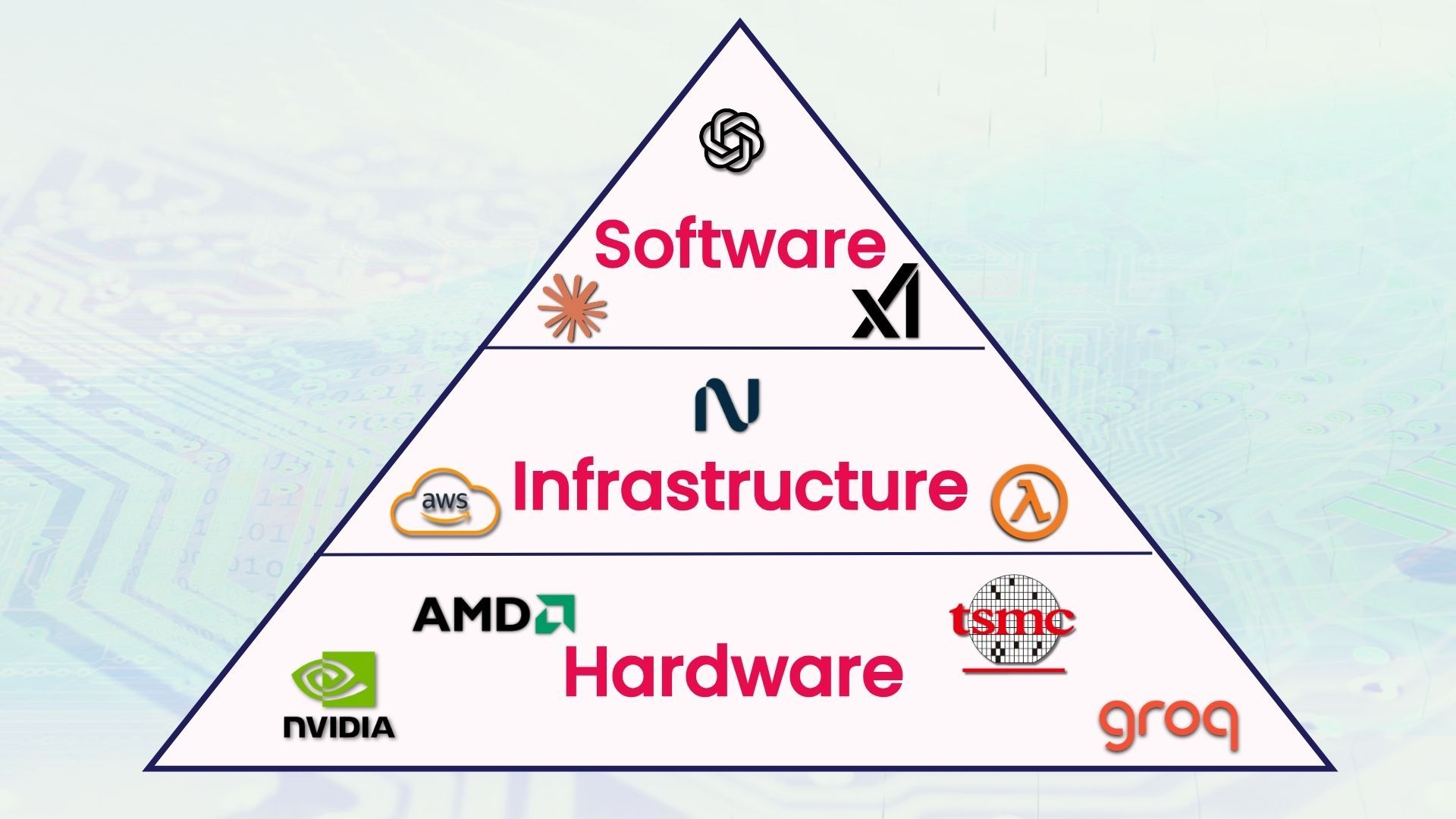
AI is computer technology that can be trained to do what humans do – thinking, learning, problem-solving. There are many different types of AI out there, including hardware, infrastructure and software.
What is hardware and why does it matter?
AI hardware means the physical components (chips, servers and processors) built to handle AI's heavy computing demands. It's made by specialist chip designers, chip manufacturers and infrastructure firms. Without hardware, AI simply can't run. Examples of AI hardware include: Taiwan Semiconductor (TSMC), Nvidia, AMD and Groq.
What is AI infrastructure?
AI infrastructure is the cloud and computing power that turns raw hardware into working AI. Hyperscalers, like Amazon Web Services (AWS), are huge cloud providers that run the vast data operations that train AI models, while newer neoclouds, like Lambda Labs, specialise in high-performance computing built specifically for AI. Together, they're the engine room between the chips and the apps you use.
What is AI software?
Software is where the AI really comes to life and is the type of AI many of us are familiar with. These are the products regular people and businesses use. It's built by two main types of companies: frontier AI labs, like OpenAI and Anthropic, which develop the underlying models, and enterprise AI firms, like Databricks, which apply AI to specific business problems.
Which are the biggest AI companies right now and where can you access them?
The AI economy is currently dominated by a handful of giants spanning hardware, software and infrastructure: chipmaker Nvidia, chip manufacturer TSMC, consumer tech firms Apple and Microsoft and AI labs Anthropic, OpenAI and xAI. In our running most popular funds, ETFs and Investment Trusts list, many hold stakes in these companies and so AI has become a crucial part of our economy.
Nvidia
Nvidia is a US hardware company that produces specialised computer chips, known as GPUs (Graphics Processing Units). Originally developed for video games, these chips have since broadened into AI applications. Nvidia has a market cap of a whopping $5.4 trillion as at September 2026. [4]
Apple
Apple makes consumer electronics, software and online services. It has invested in developing AI features for consumers through Apple Intelligence, which launched in 2024. Apple currently has a market cap of $4.96 trillion as at September 2026. [5]
Microsoft
Microsoft, similar to Apple, isn't mainly AI-focused, but it oversees consumer AI products, such as Microsoft Copilot, through a dedicated division. As a corporation, Microsoft is worth $3.7 trillion as at September 2026. [6]
Where can you access Nvidia, Apple and Microsoft?
All three sit in the major US and global indices, so most broad A fund that aims to match the performance of a global stock market index by holding shares in companies from around the world. These funds typically track indices like the MSCI World Index or FTSE All-World Index, giving investors exposure to thousands of companies across developed markets (and sometimes emerging markets too). Because they're passively managed and simply follow the index, global tracker funds have low fees compared to actively managed funds. They're a popular choice for long-term investors wanting broad international diversification without needing to pick individual countries or companies.already hold them - no special hunting required.
- A type of fund made up of a number of assets which can be bought and sold on the stock market, in the same way as you would with individual shares.:
- iShares Core S&P 500 UCITS (CSP1)
- Vanguard S&P 500 UCITS (VUSA)
- Invesco EQQQ Nasdaq-100 UCITS (EQQQ)
- iShares Core MSCI World (SWDA)
- Vanguard FTSE All-World (VWRL)
- An Open-Ended Investment Company is an investment fund that pools money from people to buy assets like cash./unit trusts:
- Fidelity Index World
- HSBC FTSE All-World Index
- Vanguard US Equity Index
- L&G Global Technology Index Trust
- Functions like a typical fund, but is structured as a public limited company (PLC) which can be traded on the stock market. Has certain exclusive capabilities, such as being able to store income during lucrative periods to maintain generous dividend payments when performance dips.:
- Polar Capital Technology Trust
- Allianz Technology Trust
- JPMorgan American
- Alliance Witan
Taiwan Semiconductor (TSMC)
TSMC is a Taiwan-based chip manufacturer that controls 70% [7] of the global semiconductor foundry market and has a market cap of $2.316 trillion.[8] It is the main supplier of chips for both Nvidia and Apple.
Where can you access TSMC?
TSMC counts as an emerging market, so standard An index that tracks the performance of the 500 largest publicly traded companies in the United States. It's often used as a benchmark for the overall global stock market. and A global index that tracks large and medium-sized companies from 23 developed countries around the world.trackers generally skip TSMC. To get exposure, you need a global "all-world" fund, an emerging-markets or Asia fund, or a dedicated semiconductor fund.
- ETFs:
- Vanguard FTSE All-World (VWRL)
- iShares Core MSCI EM IMI (EMIM)
- iShares Semiconductor UCITS (SEMI)
- OEICs:
- HSBC FTSE All-World Index
- Fidelity Emerging Markets
- Fidelity Asia
- Investment Trusts:
- Templeton Emerging Markets
- JPMorgan Emerging Markets Growth & Income
- Polar Capital Technology Trust
Anthropic
Anthropic, which owns Claude, develops Large Language Models (LLMs) and is rivalled by OpenAI. Anthropic filed for an Initial Public Offering (IPO) in June 2026 and is expected to list by the end of November 2026. As of May 2026, Anthropic is valued at $965 billion - more than OpenAI’s $852 billion. [9]
Where can you access Anthropic?
Although Anthropic is still a privately listed company, four Investment Trusts already hold a stake: Baillie Gifford US Growth, RIT Capital Partners, Schiehallion Fund and Scottish Mortgage. Baillie Gifford US Growth's Anthropic holdings are at 6.8% of Trust assets, Schiehallion's at 4.4%, and Scottish Mortgage's at 2.9%.
Data correct as at 28 September 2026
ETFs and OEICs generally can't hold Anthropic at all - these are open-ended funds that need to let investors buy and sell daily, and an unlisted, private company's shares simply can't trade that way.
OpenAI
OpenAI, which owns ChatGPT, develops generative AI models trained on large datasets to generate human-like text and content. OpenAI also filed for an IPO in June 2026 but is not expected to list until 2027 and is valued at $852 billion. [10]
Where can you access OpenAI?
Similar to Anthropic, OpenAI is still privately held. The AIC says it isn't aware of any UK Investment Trust holding an OpenAI stake.
xAI
xAI is Elon Musk's AI company, created to rival OpenAI. In early 2026, it merged with Musk’s aerospace company, SpaceX and is connected to X (formerly Twitter), also owned by Musk. xAI has developed the chatbot Grok AI, which can generate images and videos and hold conversations. Before merging with SpaceX, xAI was valued at $250 billion [11] and its market cap is currently at $1.958 trillion. [12]
Where can you access xAI?
Since SpaceX's stock market listing, access here is far easier than for Anthropic or OpenAI:
- Investment Trusts:
- Scottish Mortgage (SpaceX was 17.5% of the fund as at 31 August 2026)
- Edinburgh Worldwide
- Baillie Gifford US Growth
- Schiehallion and RIT Capital Partners.
- Not yet in S&P 500 trackers: S&P rejected fast-track inclusion on 4 June 2026, with inclusion now more likely in 2027.
Is AI here to stay?
Whatever you think about AI, there's no denying it's already woven into daily life - from the AI tools built into your phone that edit your photos, to the AI engines helping people draft work reports. It's often working quietly in the background too, in ways you might not even notice. One thing is clear: AI is here to stay.
—-
[1] Darioamondei.com
[2] BBC
[3] BBC
[4] Hargreaves Lansdown, September 2026
[5] Companiesmarketcap.com, September 2026
[6] Interactive Investor, September 2026
[7] Taipei Times
[8] Yahoo!Finance
[9] Forbes
[10] Forbes
[11] CNBC
[12] Yahoo!Finance



Post a comment:
This is an open discussion and does not represent the views of Boring Money. We want our communities to be welcoming and helpful. Spam, personal attacks and offensive language will not be tolerated. Posts may be deleted and repeat offenders blocked at our discretion.
Your opinion matters
Be the first to comment.